
Loan for Real Estate Business: How to Finance Commercial Properties and Fill the Funding Gaps

Loan for Real Estate Business: How to Finance Commercial Properties and Fill the Funding Gaps
How Real Estate Business Loans Actually Work
Most people searching for a loan for real estate business picture one tidy cheque that covers everything. That's not how it works. In practice, real estate entrepreneurs piece together a capital stack from multiple sources to buy commercial property, fund flips, execute BRRRR deals, furnish short term rentals, or acquire an existing business with property attached.
A commercial real estate loan is the primary financing tool, but it rarely covers the full cost of a deal. You'll typically also need a business loan, short term gap funding, or both to handle the down payment, closing costs, rehab draws, and working capital gaps that appear after settlement.
Quick definitions to keep things straight. Commercial real estate financing refers to any loan secured by property used for business purposes. A commercial mortgage is the specific instrument for that purchase or refinance. Owner occupied means your business uses at least 51% of the space. Investment properties are held for lease income or resale. And a business loan can be unsecured (based on your income and credit) or asset based (secured by collateral you already own).
The pain points are predictable: large down payments, tight closing timelines, rehab and soft costs that lenders won't touch, and interest rates that have climbed well above pre 2022 norms. These gaps kill deals every week, even for borrowers who technically qualify for primary financing.
That's where Gap Funded sits. We're a capital stacking partner that fills the shortfall between what banks or hard money lenders cover and the true all in project cost, with no equity splits and no liens on the deal property. A soft pull application at gapfunded.com/apply lets you check options without dinging your credit.
Commercial Real Estate Loans 101: Core Options for Real Estate Businesses
Commercial real estate loans differ from residential mortgages in almost every way that matters. Underwriting centres on property cash flow and debt service coverage ratio (DSCR), not just your personal income. Terms are shorter, balloon payments are standard, and lenders want documented experience.
Commercial real estate loan terms typically range from 5 to 30 years, though the most common structure is a 5 to 10 year note term with amortisation stretched over 20 to 25 years and a balloon at maturity. For 5+ unit multifamily properties in 2025, median note rates sat around 6.50%, median loan to value hovered near 64.5%, and roughly 76% of loans carried a balloon payment. Traditional commercial mortgages are offered by banks and credit unions under these norms.
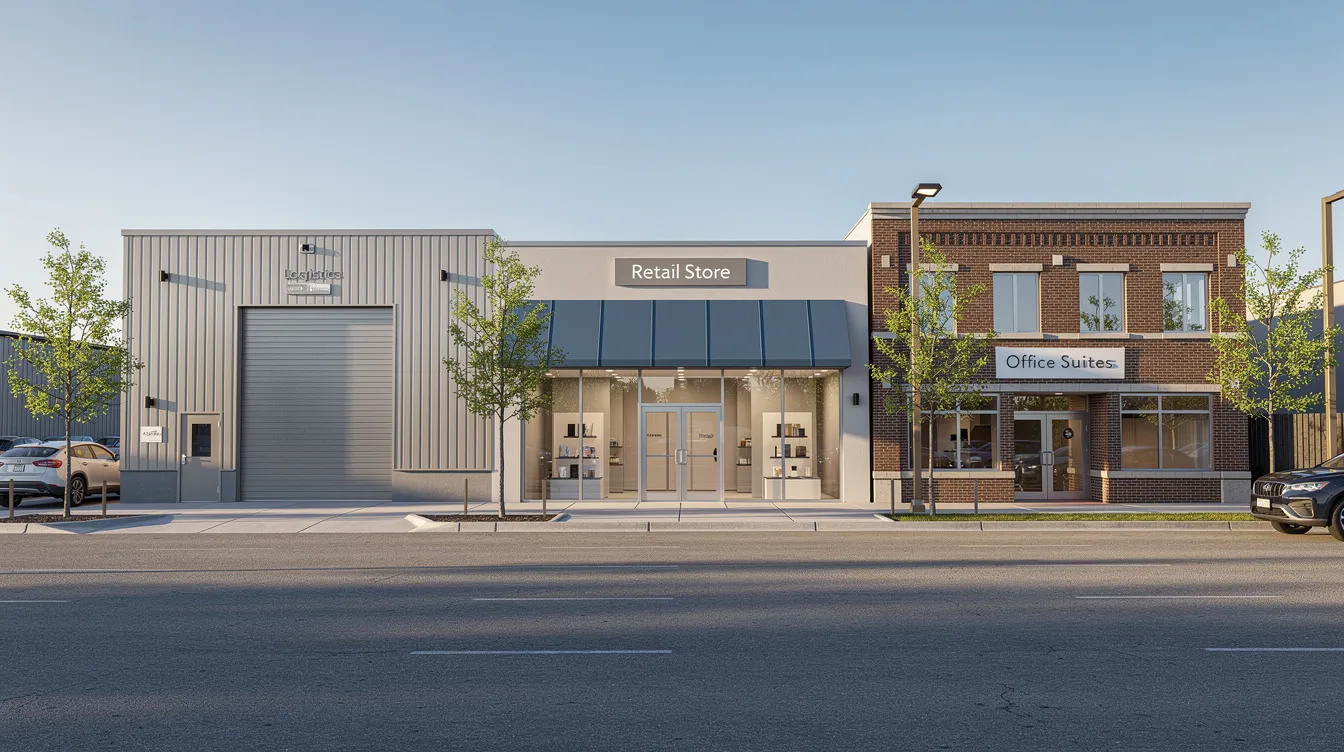
"Commercial property" covers more than office towers. Lenders include office, retail, industrial, mixed use, small multifamily (5+ units), self storage, hospitality, and special use buildings like medical offices. Each property type carries a different risk profile and pricing band.
The critical point: commercial real estate financing rarely covers 100% of purchase plus rehab plus closing plus reserves. Loan to value ratios of 80% or lower are preferred by lenders, and many commercial loans require a down payment of 20% to 35%. That gap between what the bank funds and what the deal actually costs is where most borrowers get stuck.
Banks and conventional lenders favour experienced sponsors with strong global cash flow and credit scores of 680 or above. Private and hard money lenders can be more flexible on credit and experience but charge significantly higher rates, often 12% to 18%, and require more equity upfront.
Owner Occupied vs Investment Property Loans
Lenders separate owner occupied commercial property from investment properties because the risk profiles are completely different, and the distinction affects your approval odds, leverage, and interest rates.
An owner occupied commercial mortgage means your business occupies at least 51% of the space. Think a contractor's warehouse, a dental clinic, or a restaurant in a building the operator owns. SBA loans require a minimum owner occupancy of 51% for existing buildings. These loans typically offer lower interest rates, longer repayment terms, higher loan to value, and more weight on business operating income rather than just property NOI. Real estate financing in these structures can have lower interest rates than traditional investment property loans.
Investment property mortgages cover everything else: office buildings leased to tenants, strip centres, multifamily rentals, self storage, short term rentals. Income depends on third party leases, which means lenders see higher vacancy risk and market cycle exposure. Expect more conservative LTV (65% to 80%), higher DSCR requirements, and larger down payments.
Here's the bit many readers miss: fix and flip, BRRRR, and Airbnb strategies are almost always treated as investment properties for underwriting, even if you manage the property yourself or live nearby. That changes your financing options and cost of capital significantly. Gap Funded helps both owner occupied business owners and pure investors bridge the down payment and closing cost shortfalls on either loan type.
Major Types of Loans for Real Estate Businesses
The big categories: traditional bank or commercial mortgage, SBA loans, DSCR and investor loans, hard money and construction loans, and unsecured business loans. Each has a lane.
Traditional commercial mortgages suit stabilised properties with strong leases or proven business income. Expect 20% to 30% down, DSCR of 1.25 or higher (commonly preferred by lenders), and thorough documentation. These are the cheapest money available if you can qualify, but slow to close.
SBA 7(a) loans can reach up to $5 million and cover purchasing real estate, working capital, and equipment costs, with a repayment period of up to 25 years. SBA loans range from $500 to $5.5 million depending on the program. SBA 504 loans are fixed rate loans for commercial real estate that finance fixed assets: the borrower typically puts 10% down, a bank covers 50%, and a certified development company funds up to 40% of eligible costs. Both programs require at least 51% owner occupancy and a Statement of Personal History for evaluation. The Small Business Administration designed these for small businesses pursuing business growth and job creation, including in rural areas.
DSCR loans underwrite based on property income rather than personal income. The DSCR indicates whether a property's income covers its debt payments. Rates for 1 to 4 unit investment properties in 2025 ran roughly 7.35% to 8.15% fixed, with LTVs around 75% to 80%. Investors like these because qualification hinges on rental cash flow, not tax returns.
Construction loans and rehab loans fund ground up builds and heavy renovations. Lenders distribute money in draws after inspections, rarely covering earnest money deposit, closing costs, or full soft costs. Construction costs and budget overruns are the borrower's problem until the next draw.
Bridge loans are short term loans designed for quick acquisition of properties, but interest rates for bridge loans are significantly higher than traditional loans. Hard money loans are asset based loans funded by private investors or companies, offering speed at a premium. USDA B&I loans can be guaranteed up to 80% by the USDA for eligible borrowers in qualifying areas.
Unsecured term loans and business lines of credit fill the edges: smaller rehabs, furnishings for short term rentals, or working capital while the property stabilises.
How Lenders Decide: Qualifying for a Business Loan on Commercial Property
Lenders still use the five C's of credit, but they apply them with commercial real estate specific nuances. Here's how to self assess before you apply.
Character: Most lenders require a minimum credit score of around 650, with 680+ preferred for conventional bank loans. Your track record matters: on time mortgage payments, experience managing property, and a clean personal history all factor in.
Capital: How much equity and cash are you bringing? Lenders want skin in the game via down payment, closing costs, and reserves. Having money tied up in other projects doesn't help if you can't show liquid funds.
Collateral: The property's as is value and after repair value drive LTV and loan to cost limits. Appraisals and sometimes environmental reviews are required. Lenders assess the land, the building, and the market the property sits in.
Capacity: Property cash flow (DSCR, rent rolls, leases) and global business income. Documentation requirements typically include personal and business tax returns and profit and loss statements. Pro forma projections for post rehab or post stabilisation income will be scrutinised.
Conditions: Local market trends, vacancy rates, property type risk (office is tougher than industrial right now), and the macro interest rate environment. Lenders also weigh whether the commercial space is in a growing or declining market.
Common deal killers: credit under 640, insufficient verifiable income, over optimistic pro formas, or simply not having enough capital for the required down payment and reserves. If any of those sound familiar, sort them before applying.
The Real Funding Gap: What Traditional Lenders Won't Cover
Here's the maths that catches people off guard. Say you're buying a small multifamily property for $850,000. Your bank approves 75% LTV, giving you a $637,500 loan. That leaves $212,500 in purchase equity. Then add closing costs (2% to 4%), rehab ($50,000), six months of reserves, and soft costs. Suddenly you need north of $280,000 out of pocket.
The typical uncovered costs for a real estate business loan include: down payment, earnest money deposit, closing costs, rehab overruns, contingency, furnishings for short term rentals, carrying costs (insurance, utilities, property taxes during vacancy), marketing for leasing, and working capital for the operating business.
Many investors with good credit and solid income still get stuck. Cash is locked in other projects, equity sits in a home or existing rental, or they're early enough in their business life cycle that existing debt and principal commitments limit what they can pull together quickly.
Piecing together money from merchant cash advances, friends and family, or multiple personal loans can erode deal profits, complicate your cap table, and create personal stress that no amount of money is worth. This is exactly where Gap Funded steps in as a non dilutive gap funding partner sitting alongside your main lender.
How Gap Funded Closes the Gap for Real Estate Businesses
Gap Funded is not a bank, hard money lender, or DSCR lender. We stack unsecured and asset based products around your primary commercial real estate financing to make deals closeable without giving up equity.
For borrowers with 650+ FICO, we start with unsecured tools. Credit card stacking layers multiple 0% intro APR business credit cards (9 to 18 months interest free) to cover earnest money deposits, materials, light rehab, furnishings, and closing costs. Rapid gap funding provides fixed payment unsecured term loans for down payments, rehab budgets, or consolidating expensive short term debt.
For investors with equity elsewhere, asset based tools come next. A HELOC on an investment property or primary residence can generate funds for new down payments or construction draws (use the HELOC calculator to estimate your capacity). We also connect clients with hard money and DSCR partners for primary financing on flips or rental acquisitions.
For operating businesses doing $20k per month or more in revenue, business lines of credit and business term loans cover working capital while the property stabilises.
The order matters. Start with 0% unsecured credit and term loans to preserve flexibility and collateral. Add HELOC or hard money only where secured leverage makes sense. Revenue based tools come last for ongoing liquidity. Applying out of order can knock out later approvals. We use soft credit pulls, place no liens on the subject property, and funding often moves in days rather than months.
Putting It Together: Example Capital Stacks for Common Real Estate Strategies
Here's how a capital stack actually layers in practice.
Fix and flip: $500,000 purchase plus $100,000 rehab. Hard money lender covers 80% of after repair value. Gap Funded fills the remaining down payment and closing costs with an unsecured term loan ($30,000) and 0% credit card stacking ($30,000 for initial rehab float and carrying costs). Out of pocket cash drops to near zero while profit margin stays intact.
BRRRR or small multifamily: $1.2 million building, DSCR lender at 75% LTV ($900,000 loan). Equity gap of $300,000 plus $50,000 rehab. HELOC on an existing rental covers $150,000; unsecured term loan adds $100,000; credit card stacking handles $50,000 for rehab and holding costs. After stabilisation, refinancing into a long term loan pays down the short term capital.
Owner occupied commercial purchase: A contractor buys a $600,000 warehouse using an SBA 504 loan (10% borrower equity, 50% bank, 40% certified development company). Build out, equipment, inventory, and closing add $100,000 the SBA loan won't cover. Gap Funded's unsecured term loans and a business line of credit fill the gap, keeping the deal on track without leasing from someone else.
In every scenario, the principle is the same: cheapest and least encumbered capital first, then layered support. And always stress test your cash flow before stacking short term debt. If the deal can't survive a two month vacancy or a 15% rehab overrun, reconsider the purchase rather than stacking more.

Next Steps: Choosing the Right Loan and Filling the Gaps
Start by defining your business needs: owner occupied or investment, purchase or refinance, stabilised or value add. Then estimate total project cost honestly, including all soft costs, contingency, and carrying costs. Identify the primary financing option (bank, SBA, DSCR, hard money) that fits your deal type and eligibility criteria.
Calculate the funding gap explicitly: down payment, closing costs, rehab budget, working capital, contingency. Decide how much you want to fund through non dilutive gap funding versus your own cash. Most borrowers who run this exercise find the gap is 15% to 30% larger than they initially assumed.
A bank or SBA lender is the right first call for owner occupied deals with a detailed business plan and strong financials. A DSCR lender fits stabilised rentals. Hard money suits flips and heavy rehab. But when any of those lenders can't move fast enough, won't cover the full stack, or you're a newer investor without a long track record, gap funding fills the space between "approved" and "closed."
Gap Funded sits alongside any of those lenders. No equity splits, no liens on the deal property, soft credit pulls, and fast execution. If you've got a deal in mind, a credit score of 650 or above, and a gap to fill, share your deal size and timeline via the quick funding review. Hard money brokers, wholesalers, and business loan brokers can join the referral partner programme.
Related Reading
This article is for educational purposes only and isn't financial, legal, tax, or investment advice. Credit and financing outcomes depend on your own situation. Talk to a licensed financial professional before making funding decisions for your business.