
Commercial DSCR Loan: Investor's Guide to Debt Service Coverage Ratio Financing

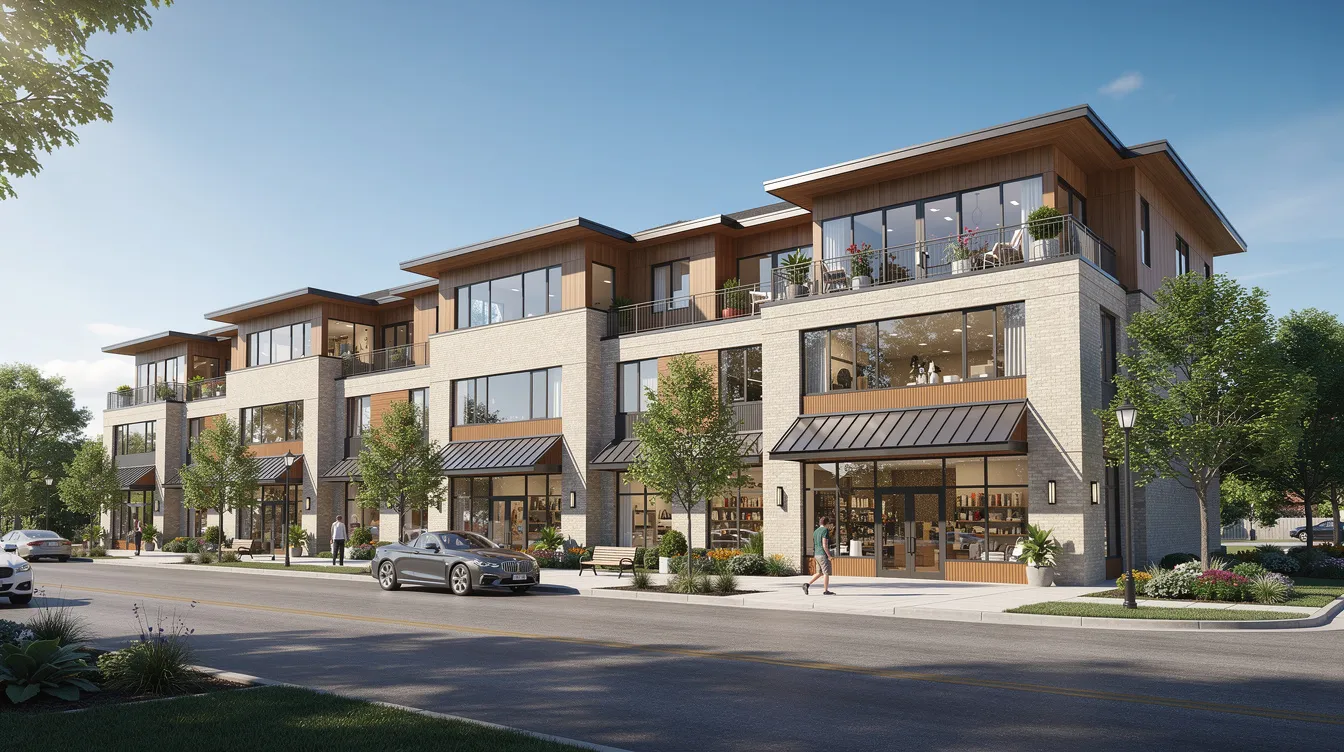
Commercial DSCR Loan: Investor's Guide to Debt Service Coverage Ratio Financing
Introduction: What Is a Commercial DSCR Loan and Who Is It For?
Most real estate investors hear "DSCR loan" and think of single family rentals. Fair enough. But a commercial DSCR loan is a different animal. It is a commercial real estate loan underwritten primarily on the property's cash flow rather than your personal income, W2s, or tax returns. That means the lender cares about whether the building pays for itself, not whether you had a rough year on your 1040.
A commercial DSCR loan evaluates properties based on cash flow, specifically net operating income divided by annual debt service. It covers offices, retail strips, industrial warehouses, mixed use property, and multifamily buildings with five or more units. Properties financed typically include multifamily buildings, retail spaces, and office buildings. By contrast, residential DSCR loans target one to four unit rentals, and conventional loans often demand employment verification, full personal financial history, and heaps of paperwork.
Here is the catch most people miss: qualifying for the loan and having enough cash to close are two separate problems. In 2026, most commercial lenders target a minimum DSCR ratio of around 1.20 to 1.30 for stabilised commercial assets, which means the property needs to generate 20 to 30 percent more income than the debt payments require. Even when your numbers work, you can still be short on down payment, closing costs, rehab, or working capital. That funding gap is exactly what Gap Funded helps solve.
How Commercial DSCR Loans Work (Core Concepts)
Underwriting for a commercial DSCR loan focuses on the property performance rather than personal financial history. Lenders look at three things: cash flow, leverage, and risk. Your credit score matters, but not as much as whether the building's rental income covers the debt.
The debt service coverage ratio for commercial mortgages is calculated as DSCR equals net operating income (NOI) divided by annual debt service. Annual debt service means your total principal and interest payments over twelve months. The residential investor version is simpler: gross monthly rent divided by PITIA (principal, interest, taxes, insurance, association dues). Commercial underwriting digs deeper.
DSCR is crucial for assessing loan eligibility and size. Here is a quick example. Say a property generates $300,000 in net operating income NOI. Annual debt payments on the proposed loan total $240,000. That gives you a DSCR of 1.25. Most lenders require a minimum DSCR of 1.0 to 1.25, and a DSCR of 1.25 or higher is considered strong. If interest rates rise or your amortisation shortens and debt service climbs to $260,000, the DSCR drops to about 1.15, which may push you below the lender's threshold. DSCR requirements vary by lender and property type, so there is no single universal threshold.
Key Commercial Property Types Eligible for DSCR Financing
Property type strongly affects the minimum DSCR ratio, maximum LTV, interest rates, and how much documentation lenders require. Here is what to expect in 2026:
- Office: Vacancy risk remains elevated post pandemic. Most commercial lenders want a DSCR of 1.30 to 1.40 or higher, long lease terms, and creditworthy tenants. Suburban office with stable tenants fares better than urban Class B or C.
- Retail: Grocery anchored or credit tenant anchored strips sit comfortably around 1.25 to 1.35 DSCR. Unanchored centres with a weaker tenant mix face stricter terms.
- Industrial and warehouse: Strong demand, long leases, and low turnover. DSCR minimums often land at 1.25 to 1.35 for stabilised assets.
- Multifamily (5+ units): Lenders prefer properties with a DSCR above 1.20 for stabilised suburban multifamily. Strong occupancy and consistent rental income help.
- Mixed use: If the property is majority residential, some lenders use residential DSCR programs. If majority commercial, full commercial underwriting applies with blended risk adjustments.
- Self storage: Underwritten similarly to industrial but with market saturation risk factored in.
- Hospitality: Hotels typically require a DSCR of 1.40 or higher due to revenue volatility. Many commercial DSCR lenders avoid hospitality altogether unless the operator has deep experience.
Raw land and heavy value add projects with little or no in place rental income generally do not fit traditional commercial DSCR loans. Those deals usually need bridge or hard money financing instead.
Calculating DSCR and Net Operating Income (With Simple Examples)
Accurate NOI is the foundation of every successful DSCR loan request, and lenders will "normalise" your numbers whether you like it or not.
Here is a simplified NOI calculation for a 12 unit mixed use building:
- Gross rental income: $220,000
- Other income (parking, CAM reimbursements): $15,000
- Less vacancy and credit loss at 6%: minus $14,100
- Effective gross income: $220,900
- Less operating expenses (property taxes, insurance, utilities, management fees, maintenance, reserves): minus $88,000
- Net operating income: $132,900
Now suppose the proposed loan carries $106,000 in annual debt service. DSCR equals $132,900 divided by $106,000, which is about 1.25. That meets most lender thresholds. But if the lender bumps vacancy to 8% and adds a 5% management fee you did not include, underwritten NOI might drop to $122,000 and your DSCR slides to 1.15. A DSCR below 1.0 indicates insufficient income to cover debts and negative cash flow for borrowers, so even a slight underwriting haircut matters.
For portfolio investors, some lenders assess a global DSCR by combining NOI and total debt service across multiple investment properties. A strong global DSCR can offset a weaker single property ratio.

Commercial DSCR Loan Requirements in 2026
Requirements shift by lender and property type, but common patterns hold across the market in 2026:
- Credit score: A minimum personal credit score of 680 is often required to secure a commercial DSCR loan. Investors with 700 or above and a good DSCR typically unlock better pricing and higher leverage. Higher DSCR ratios can secure lower interest rates for borrowers.
- Down payment and LTV: Down payments for commercial DSCR loans usually range from 20% to 30% of the property value. Maximum LTV generally runs 65% to 75% for core property types in primary markets. Larger down payments may be required for riskier assets or lower credit profiles.
- Minimum DSCR: Most commercial lenders generally require a minimum DSCR between 1.20 and 1.25 on in place income. Riskier types like hotels or older office buildings may need 1.35 to 1.50 or more. A DSCR of 1.25 is often considered optimal for loans. Lenders prefer properties with a DSCR of 1.20 or higher for approval.
- Reserves: Lenders may require liquid reserves equivalent to 3 to 6 months of mortgage payments after closing. For larger or more complex commercial mortgage requests above $1M, some lenders ask for 6 to 12 months.
- Documentation: Even with less paperwork than conventional loans, lenders require rent rolls, trailing 12 or 24 month operating statements, lease copies, entity documents, an operating agreement, and personal financial statements. No employment verification or tax returns in many programs, but the property's rental income and payment history still get scrutinised.
Loan Structure: Terms, Interest Only Periods, and Prepayment Penalties
Beyond rate and LTV, the structure of a commercial DSCR loan has a big impact on your cash flow and exit flexibility.
Typical terms in 2026 include 5, 7, or 10 year fixed or hybrid periods with 20 to 30 year amortisation and a balloon payment at maturity. That means your monthly payment is sized as if you are paying over 25 or 30 years, but the full balance comes due after the fixed term.
Some lenders offer interest only periods of 1 to 5 years. During interest only, you pay only interest payments, which improves early DSCR and cash flow. But when full amortisation kicks in, debt service jumps and DSCR can tighten unless NOI has grown. DSCR is crucial for assessing loan eligibility and risk at both stages.
Prepayment penalties are almost universal in commercial loans. Common structures include:
- Step down (e.g., 5, 4, 3, 2, 1 percent of outstanding principal per year): declines annually
- Yield maintenance: borrower pays the present value of interest the lender would lose, which can be expensive if rates have dropped
- Defeasance: replacing the property with a portfolio of government securities as collateral, common in CMBS deals
If you plan to sell or refinance in three years but take a loan with a five year step down, the prepayment hit can be a fair whack. Model your exit dates against the penalty schedule before signing. Some lenders charge higher rates for reduced or no prepayment penalties, so weigh higher monthly payment cost against flexibility.
Underwriting Nuances: Global DSCR, Tenant Risk, and Property Value
Beyond the basic maths, underwriters dig into the quality of the income behind the property's net operating income.
- Global DSCR: When lenders aggregate NOI and debt across your entire portfolio, a strong global DSCR can compensate for a weaker single property DSCR ratio. This is common for experienced operators with diversified holdings.
- Tenant and lease risk: Credit tenants on long leases make deals easier. Short remaining lease terms, upcoming rollovers, or co tenancy clauses in retail can push underwriters to demand higher DSCR or lower LTV. The property's ability to retain tenants matters as much as current occupancy.
- Appraisal: Commercial appraisals typically use the income approach (capitalising NOI at a market cap rate), sales comparisons, and sometimes cost approach. Cap rate and DSCR are different metrics, but both influence property value. An appraisal report may reduce lender accepted NOI by applying higher vacancy assumptions or normalised operating expenses, which in turn lowers DSCR and forces a smaller loan amount.
Even with a strong personal balance sheet, a property with poor tenants, declining submarket, or thin unit mix can trigger lower leverage or extra conditions. The lender cares about the property's ability to generate enough income on an annual basis, not your net worth.
Common Use Cases: Purchase, Rate and Term Refinance, and Cash Out Refinance
Commercial DSCR loans serve three main purposes.
Purchase: Loan to value and minimum DSCR dictate the maximum loan amount and therefore required equity. For example, a $3M retail strip centre at 65% LTV requires $1.05M in equity. If the property shows a DSCR of 1.30 on the proposed loan size, you are in solid shape. If DSCR dips below the minimum DSCR ratio, the loan amount shrinks and your equity gap grows.
Rate and term refinance: Investors use DSCR loans to extend amortisation, lock in a fixed rate, or shift from bridge or hard money into a permanent commercial mortgage. This is common for properties bought with short term financing that are now stabilised and rent ready.
Cash out refinance: When DSCR and LTV allow, investors tap built up equity. Common uses of proceeds include capital expenditures, new acquisitions, debt consolidation, or buying out partners. Lenders will scrutinise post refinance DSCR carefully to ensure the property still has a good DSCR and a healthy cushion above 1.20x. According to DSCR Capital Partners data, nearly 47% of recent DSCR loans were cash out refinances.
Where the Numbers Break: Identifying Your Commercial Funding Gap
Here is the part nobody talks about at the start: even when a commercial DSCR loan is approved, most investors still lack enough cash to actually close the deal.
DSCR lenders and banks typically stop at funding 65% to 75% of purchase price or appraised value. Everything else is on you. The specific gap categories include:
- Down payment on acquisitions (20% to 30% of property value)
- Closing costs and third party fees (appraisals, environmental reports, legal, title)
- Rehab, tenant improvements, and leasing commissions
- Operating reserves and interest carry during lease up
- Earnest money deposits required well before closing
- Business working capital or inventory for owner user commercial property
Here is a practical scenario. A $2.5M commercial property financed at 70% LTV gives you a loan amount of $1.75M. That leaves $750K in equity. Add closing costs ($75K), tenant improvements ($100K), and contingency reserves ($50K). Your total gap is roughly $975K. The DSCR loan covers the big piece, but you still need nearly a million dollars from somewhere.
Most DSCR lenders will not finance these shortfalls. Raising all of it from equity partners means diluting your returns and control.

How Gap Funded Complements Commercial DSCR Loans
Gap Funded is not a DSCR lender, hard money lender, or private money shop. We are a capital stacking specialist that works alongside your DSCR lender to fill the gap between what they fund and what you actually need to close.
The goal is to keep you in control of your deal. No equity splits, no liens on the deal property. The tools we use include:
- Unsecured personal term loans for down payment, closing costs, or earnest money deposits
- Business credit card stacking at 0% intro APR for rehab, leasing, and working capital
- Business lines of credit to manage cash flow during lease up or improvements
- HELOCs on investment property or primary residence equity
- Rapid gap funding tied to specific transaction deadlines
Typical qualification starts at 650 or above FICO, provable income or business revenue, and capacity to service short term debt alongside your DSCR loan obligations. Our review begins with a soft credit pull. No impact to your credit just to check options. You can explore all available gap funding services on our site.
Choosing the Right Gap Funding Tool for Your Situation
Different shortfalls call for different tools, and the order you apply matters because each approval can affect the next.
- First: Evaluate unsecured gap funding options like personal term loans or credit card stacking when the need is primarily for down payment, closing costs, or early rehab and you have strong personal credit.
- Second: Consider asset based options like a HELOC on your primary residence or investment property when there is sufficient equity and a longer runway is needed. Our HELOC calculator can help you model scenarios.
- Third: For established businesses with at least two years of operating history and $20K or more monthly revenue, explore revenue based capital such as a business line of credit or business term loans to stabilise cash flow alongside the DSCR loan.
This sequence makes sense because unsecured options are fast and flexible for smaller gaps, HELOCs provide larger capacity at lower interest rates, and revenue based tools fit operating businesses tied to the commercial asset.
I will be candid: hard money and merchant cash advances can close quickly, but often at very high effective rates and aggressive terms. Equity partners solve the cash problem but dilute long term returns and control. Our gap funding overview page breaks down how these tools combine with DSCR loans. Many clients use two or three together.
Putting It Together: Action Steps to Secure a Commercial DSCR Loan Plus Gap Funding
Commercial DSCR financing is absolutely achievable for investors who prepare their financials and plan for the gap ahead of time. Here is the step by step:
- Underwrite your own deal: Estimate NOI, calculate DSCR on realistic terms, and verify it meets common minimum DSCR ratio benchmarks for your property type.
- Get indicative terms: Talk to a DSCR lender or commercial mortgage broker about loan amount, rate, amortisation, reserves, and prepayment penalties.
- Quantify your capital stack: Add up required equity, closing costs, rehab or tenant improvements, reserves, and working capital.
- Identify the shortfall: The funding gap is the difference between what the DSCR loan covers and total cash needed to close and stabilise the property.
- Apply with Gap Funded: Submit a quick application at gapfunded.com/apply for a consolidated funding review. One soft credit pull assesses unsecured, HELOC, and revenue based options simultaneously.
- Coordinate timelines: DSCR loans often take 30 to 60 days to close. Many Gap Funded tools approve faster. Sync everything so capital arrives when your purchase contract, rehab schedule, or refinance date requires it.
Build in contingency cushions for delays and cost overruns. I reckon every deal takes a bit longer and costs a bit more than the spreadsheet says.
If you are actively pursuing a commercial DSCR loan in 2026, start by mapping out your funding gap before you go hard on earnest money. Apply at gapfunded.com/apply to see exactly which tools you qualify for. Soft pull, no commitment, no surprises.
Related Reading
This article is for educational purposes only and isn't financial, legal, tax, or investment advice. Credit and financing outcomes depend on your own situation. Talk to a licensed financial professional before making funding decisions for your business.