
Rehab Hard Money Loan: How These Loans Work, What They Really Cost and How Gap Funding Closes the Cash Gap

Rehab Hard Money Loan: How These Loans Work, What They Really Cost and How Gap Funding Closes the Cash Gap
Introduction: What a Rehab Hard Money Loan Is (and Why Real Estate Investors Use It)
Most real estate investors don't lose deals because they can't find a lender. They lose deals because the lender covers 70% and nobody planned for the other 30%.
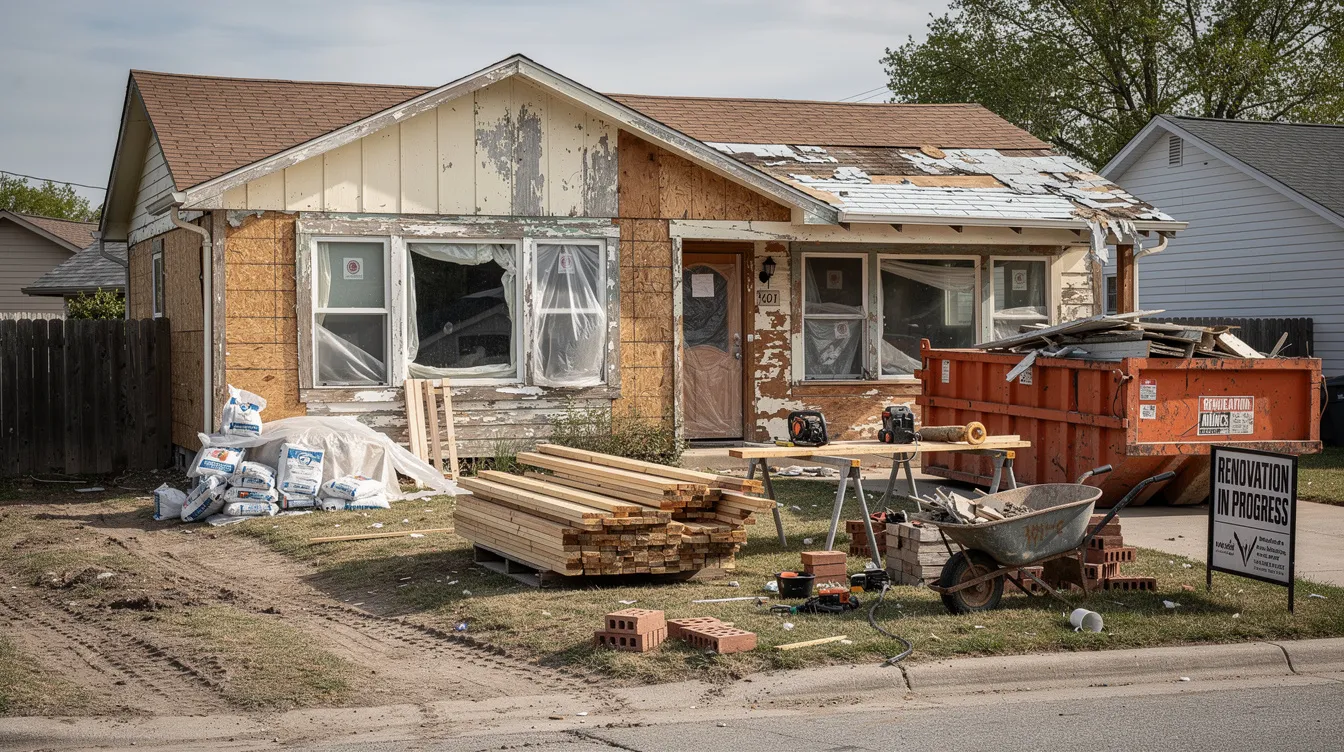
A rehab hard money loan is a short term, asset based money loan built for one purpose: buy a distressed property, renovate it, and either sell it for profit or hold it as a rental property through the BRRRR strategy (that's Buy, Rehab, Rent, Refinance, Repeat). Unlike conventional loans, rehab loans finance both the purchase and renovation costs, and approval focuses primarily on the property's after repair value rather than your personal income or debt to income ratio. Hard money loans can finance distressed properties that simply do not qualify for traditional financing.
The structure is straightforward. Your hard money rehab lender wires the purchase price at closing, holds the rehab funds in escrow, releases renovation funds in draws as milestones are completed, and you make interest only payments each month until you sell or refinance. The principal comes due as a balloon at the end.
Here's where we come in. Gap Funded is not a hard money lender or a private lender. We specialise in closing the funding gap around your primary rehab loan: down payment, closing costs, rehab overages, reserves, and working capital. The goal is to help real estate investors doing fix and flip projects or BRRRR in 2026 pair a rehab hard money loan with smart gap funding tools instead of giving away half the profit to an equity partner.
How Rehab Hard Money Loans Work (Step by Step Overview)
Understanding how these loans work from start to finish helps you avoid surprises. Here's the lifecycle:
- Deal submission. You send the hard money rehab lender your purchase contract with the purchase price, a detailed rehab scope and renovation budget, contractor bids, ARV comps, and your basic borrower's financial profile.
- Underwriting. The lender evaluates the deal, not just you. They run an appraisal on the property's after repair value, review your rehab budget for realism, and check your credit and experience. Hard money lenders focus on the property's projected ARV and profit potential. Fast funding allows hard money lenders to process deals in days rather than weeks.
- Term sheet and approval. You receive terms: interest rate, loan term (typically 6 to 18 months), points, draw schedule, and required equity contribution.
- Closing. Loan docs get signed, the purchase price is wired, and rehab funds are held back. Hard money loans typically close in 7 to 14 days. You pay origination fees and points upfront.
- Rehab draws. You start the renovation. Funds are released in stages as project milestones are completed, usually after an inspection. Most lenders release 3 to 6 draws across the project.
- Exit. You sell the property or refinance into a longer term loan, repay the principal plus accrued interest, and (ideally) pocket the profit.
Most hard money lenders will fund up to 65% to 75% of the after repair value and 80% to 90% of total project cost. That means you still need to bring 10% to 30% of your own capital plus closing costs and reserves. That equity requirement is exactly where Gap Funded's unsecured term loans, 0% business credit card stacking, and HELOC style products come into play.
Key Numbers: ARV, Purchase Price, LTV, LTC and How Much Cash You Actually Need
Before you shop for a rehab hard money loan, you need to get comfortable with three numbers. Mess these up and the whole deal falls apart.
- ARV (After Repair Value): The estimated market value of the property once all renovations are done, based on comparable sales of similarly rehabbed properties. Loan amounts are capped at 65% to 75% of ARV.
- LTV (Loan to Value): The loan amount divided by the property's current or after repair value. Most hard money rehab lenders cap this at 65% to 75% of after repair value.
- LTC (Loan to Cost): The loan amount divided by total cost (purchase price plus rehab cost plus soft costs). Strong borrowers can access 85% to 90% LTC; first time investors might see 75% to 85%.
Here's a worked example. Say you find a deal in Cleveland: purchase price of $160,000, rehab cost of $60,000, and an ARV of $320,000.
| Metric | Calculation | Result |
|---|---|---|
| Total project cost | $160,000 + $60,000 | $220,000 |
| Maximum loan at 85% LTC | 85% × $220,000 | $187,000 |
| Maximum loan at 70% ARV | 70% × $320,000 | $224,000 |
| Actual loan (lower of the two) | $187,000 | |
| Cash gap (before fees) | $220,000 − $187,000 | $33,000 |
But $33,000 isn't the full picture. Add lender points (1% to 4% of the loan amount), closing costs, inspection and draw fees, prepaid interest, insurance, property taxes, and reserves. Realistically, you might need $40,000 to $50,000 in cash to safely execute this project. That's the gap Gap Funded is built to fill.
Rehab Hard Money Loans vs. Conventional Rehab Loans and DSCR Loans
Three main financing options exist for renovation projects, and each fits a different situation.
Hard money rehab loans are asset based. Underwriting centres on the property's projected ARV and deal economics, not strict credit criteria or your debt to income ratio. They close fast and finance heavy rehabs on distressed properties. The trade off is cost.
Conventional renovation loans like FHA 203(k) and Fannie Mae HomeStyle are cheaper but restrictive. FHA 203(k) loans require a minimum rehab cost of $5,000 and are only available for owner occupied homes, not investment property. HomeStyle loans finance renovation costs up to 75% of ARV but require full income verification, W2s, tax returns, and 30 to 60 days to close. Traditional lenders and conventional lenders simply won't fund a gutted duplex you bought at auction.
DSCR loans underwrite based on property rental income, not personal income. They're designed for stabilised rental properties generating cash flow, not for mid rehab projects. DSCR rental loans come later in the process, typically as the refinance leg after a flip or BRRRR.
Bridge loans are short term financing solutions for real estate investors that help cover the gap between property acquisition and permanent financing. Bridge loans typically require interest only payments during the term and are useful for quick acquisitions before longer term financing is secured. In many contexts, bridge loans can be used interchangeably with hard money loans.
The common investor path: use a hard money rehab loan to buy and reposition, then refinance into a DSCR loan or conventional investment property loan after repair and lease up. I'll be candid: conventional lending is cheaper over the long run for highly qualified borrowers. But if the property needs a new roof, new plumbing, and has no functioning kitchen, conventional lenders are going to laugh you out of the room. Hard money financing exists precisely for those deals.
Typical Terms, Costs, and Fees on Rehab Hard Money Loans
Understanding total cost of capital (not just the rate) is what separates investors who make money from those who wonder where it all went.
- Interest rates: Hard money loans typically feature higher interest rates than conventional loans, often between 8% to 15%. In 2026, most rehab hard money loans sit in the 9% to 12% range for experienced borrowers; first time investors may see rates pushing into the low teens.
- Repayment terms: Usually 6 to 24 months. Most fix and flip loans need about 9 to 12 months.
- Points and origination fees: 1 to 4 points (1% to 4% of the loan amount) due at closing. Riskier deals or higher leverage can push this higher.
- Payment structure: Interest only payments monthly, with principal due at payoff. No amortisation.
- Other fees: Underwriting fees, appraisal fees, inspection fees per draw, extension fees if your project runs past the initial loan term, and possible prepayment penalties or minimum interest clauses for early payoff.
Returns on hard money loans can significantly erode profit margins due to high costs associated with borrowing. You also need to budget for carrying costs: builder's risk insurance, hazard coverage for vacant property, property taxes, utilities, and HOA dues if applicable.
My advice: run a full project pro forma that includes loan interest, points, extension fees, gap funding costs, and a 10% to 15% contingency on the rehab budget. If the deal still works after all that, you've got a real deal. If it only works on the "best case" numbers, it's probably not a deal at all.

Qualification: What Hard Money Rehab Lenders Actually Look At
Hard money is more flexible than banks, but it's not free money with no questions asked.
Property and deal criteria:
- Minimum ARV that supports the loan at 65% to 75% of after repair value
- Acceptable property types: single family, small multifamily (2 to 4 units), sometimes mixed use. Properties with five or more units often require different programmes.
- Clear renovation plan with contractor bids and a realistic rehab budget
- Geographic coverage (some lenders only operate in certain states)
Borrower criteria:
- Credit: Many lenders set minimum credit score requirements around 620 to 680 FICO. Credit reports are reviewed but carry less weight than the deal itself. Lenders prioritise property based factors over borrower qualifications.
- Hard money lenders often do not require income verification the way traditional lenders do, and many hard money lenders won't underwrite strict debt to income ratio guidelines. But they still look at your global financial picture.
- Hard money lenders evaluate deals based on the property's profit potential rather than strict credit criteria. Approval focuses primarily on the property's value rather than personal income.
- Liquidity: proof you can cover monthly payments, contingencies, and carrying costs for 3 to 6 months.
- Experience: prior flips or rehab experience improve leverage and pricing. First time investors may need to provide additional equity or documentation, or partner with an experienced contractor.
For self employed investors, the lighter income verification is a significant advantage over conventional lenders. Your personal finances matter less than the deal.
Gap Funded can help reasonably strong borrowers (650+ FICO and stable income or business revenue) shore up their cash position and present a stronger package to hard money rehab lenders.
The Funding Gap: Where Rehab Hard Money Loans Stop and Your Cash Problem Starts
Here's the scenario I see every week. A real estate investor in Atlanta finds a distressed duplex, secures a hard money rehab loan at 70% ARV, and still needs $45,000 for down payment, closing costs, reserves, and a contingency buffer for rehab overruns. High upfront cash reserves are often required for hard money loans, typically 20% to 35% down payments.
The typical gaps break down like this:
- 10% to 30% of total project cost as required equity
- Lender points and origination fees at closing
- Earnest money deposit before closing
- Upfront materials or labour costs before the first draw
- Reserves required by the lender (3 to 6 months of monthly payments)
- Contingency for surprises (and there are always surprises)
Many real estate investors try to cover these gaps with high APR personal loans, cash advances on business credit cards at 25%+ interest, or equity partners who take 50% of the profit. Those solutions are either expensive, dilutive, or both.
Gap Funded fills these specific gaps: down payment, closing costs, rehab expenses beyond what the lender reimburses, carrying costs during rehab, and working capital to keep other projects or a new business running. By filling these gaps with unsecured or asset based capital, investors can use rehab hard money loans at full effect without surrendering equity in the deal.
Learn more about gap funding options or start an application with a soft pull that has no impact on your credit score.

Gap Funded Tools That Pair Well with Rehab Hard Money Loans
Gap Funded is not a hard money rehab lender. We stack multiple funding tools around your primary rehab loan to cover everything your hard money lender won't finance. Here are the tools, in the order that matters:
- Debt consolidation: If existing high interest debt obligations are eating your monthly cash flow or dragging your credit profile, cleaning that up first opens the door to better terms on everything else.
- Unsecured personal term loans: Best for $20,000 to $150,000 in quick down payment and closing cost funding on fix and flip projects with a 6 to 12 month timeline.
- 0% introductory APR business credit card stacking: Ideal for materials, contractor deposits, and short term rehab costs. You pay zero interest during the introductory period, which often aligns with a typical flip timeline.
- HELOC or HELOC style lines on your primary residence or existing investment property: Larger, lower rate capital for investors who have equity to tap. An investment property line of credit allows ongoing access to renovation capital across multiple deals.
- Business lines of credit and working capital: For experienced operators with 2+ years of business revenue who need flexible, revolving capital.
This order matters. Applying out of sequence can knock out later approvals. We start with the lowest overall cost and longest useful life, then add flexible revolving options for variable rehab expenses.
Realistic qualifications: typically 650+ FICO, verifiable income or revenue, and a total funding request that aligns with your credit profile and project economics.
Designing Your Capital Stack: Combining Rehab Hard Money, DSCR, and Gap Funding
Think of your capital stack as layers. The senior layer is your rehab hard money loan covering the bulk of the purchase price and rehab. The second layer is Gap Funded capital (unsecured term loans, credit stacking, HELOC) covering equity, overages, and reserves. The final layer is your exit: a sale or a refinance into longer term debt.
For a BRRRR scenario in 2026, it looks like this: buy with a hard money rehab loan, use Gap Funded capital for down payment and rehab overages, complete the renovation, lease the property, then refinance into a DSCR loan based on cash flow from rental income rather than personal income. DSCR loans are crucial for the BRRRR strategy because they allow investors to refinance based on the property's performance. BRRRR allows investors to recycle capital across multiple deals, and investors typically refinance into long term debt after completing the process. Hard money loans are often used in the BRRRR process as the acquisition and rehab leg.
A solid business plan can improve loan approval chances with both your primary lender and with Gap Funded. Don't over leverage. Stress test your monthly payments and interest only obligations under slower than expected sale or refinance timelines.
Our pre qualification review helps you see how much unsecured and asset based capital you can realistically layer on top of a rehab loan without suffocating your cash flow. Think beyond a single deal and design a reusable capital stack you can deploy across multiple renovation projects.
Underwriting and Application Prep: How to Get a "Yes" from Rehab Lenders and Gap Funded
Preparation speeds approvals with both hard money rehab lenders and Gap Funded. Investors need a detailed renovation budget for approval, and having everything ready before you submit a loan application saves days.
Assemble before you apply:
- Recent credit report (know your score before anyone pulls it)
- Two years of tax returns or P&L statements if you're self employed
- Pay stubs or revenue statements
- A clean rehab budget with line items and contractor estimates
- Purchase contract with a realistic purchase price
- Conservative ARV supported by comps
- A clear exit plan (flip or refinance)
Hard money rehab lenders may not require full income verification or detailed debt to income ratio calculations, but Gap Funded's unsecured term loans, HELOCs, and credit card stacking will look at income, existing debt obligations, and credit history. Be honest about current debts, monthly payments, and prior credit issues. Hiding problems slows approvals and can lead to declines late in the process.
Start with a soft pull, no obligation funding review at gapfunded.com/apply. No impact on your credit score.
Managing Risk: Timelines, Prepayment Penalties, and Exit Strategies
Rehab hard money loans are powerful but unforgiving if you miss deadlines, ignore prepayment penalties, or misjudge your exit. Short term loans demand respect for time.
Timeline risks: Permit delays, contractor issues, material shortages, and market slowdowns can all push your project past the original loan term. I reckon adding 15% to 20% to both your timeline and rehab budget is the bare minimum for responsible planning.
Prepayment penalties and minimum interest: Some hard money lenders impose minimum interest clauses, meaning even if you flip in four months, you might pay interest as if you held the loan for six. Ask about this before signing anything.
Choosing your exit: Immediate flip sale works for fix and flip loans in hot markets. A cash out refinance into a DSCR rental loan or conventional investment property loan suits BRRRR strategies where rental demand and cash flow justify holding. Your choice depends on interest rates, rental income potential, and tax strategy.
Having extra liquidity from Gap Funded can prevent forced fire sales when projects slip a month or two. If you can cover extended monthly payments and carrying costs without panic, you keep control of the exit.
Model worst case outcomes. If the deal doesn't work when the rehab takes three extra months and costs 15% more, it's not a deal. It's a gamble.

When a Rehab Hard Money Loan Is (and Isn't) the Right Tool
Hard money rehab loans are one tool in the toolbox. A great one for the right job. A terrible one for the wrong job.
Where hard money rehab loans shine:
- Deeply discounted distressed properties needing significant work
- Tight closing timelines where cash buyers are competing and you need to close in days
- Properties that won't qualify with conventional lenders or traditional financing
- BRRRR projects where you plan to refinance soon after stabilisation
- Fix and flip projects where speed and flexibility matter more than rate
Where alternatives may be better:
- Light cosmetic updates where a HELOC or unsecured rehab loan might be cheaper
- Long term holds with minimal rehab that fit cleanly into a DSCR or conventional investment property loan from day one
- New construction loans for ground up builds that need longer terms and different draw structures
I'll be straight with you: Gap Funded does not replace a solid primary rehab loan. Our role is to enhance deals that already make sense, not to make bad deals look good. If the numbers don't work before gap funding, they won't work after it either.
Talk to a trusted hard money rehab lender about the primary loan. Talk to us about the gap. Compare structures and decide whether your project is best served by hard money, a DSCR loan, a HELOC style investment property line, or a blend.
Ready to see what you qualify for? Submit a simple online application at gapfunded.com/apply for a personalised funding plan combining rehab hard money loans with smart gap funding. No equity splits. No liens on the deal property. Just capital where you need it, when you need it.
Related Reading
This article is for educational purposes only and isn't financial, legal, tax, or investment advice. Credit and financing outcomes depend on your own situation. Talk to a licensed financial professional before making funding decisions for your business.