
How to Pay Off a HELOC Faster (Without Derailing Your Other Goals)


A HELOC is a revolving line of credit secured by your house. During the draw period (usually 5 to 10 years), you can borrow, repay, and re-borrow up to your limit while making interest only payments. Once the draw period ends, the repayment period kicks in and you start paying principal plus interest, often over 10 to 20 years. Accelerating that payoff can save you thousands in total interest and protect your home equity from getting chewed up by a variable rate.
Many homeowners and real estate investors use a HELOC to pay for home improvements, consolidate higher interest debt, or even to pay off a mortgage early. That flexibility is brilliant until you realise you've been treading water on interest payments for years with the balance barely moving. HELOCs have variable interest rates that can increase over time, and when the draw period flips to full repayment, your monthly payments can jump hard enough to throw your whole budget sideways.
This article walks through concrete strategies to pay off a HELOC faster, then covers when it makes sense to use tools like a home equity loan, first lien HELOC structures, or gap funding to stay liquid while still getting debt free sooner. No fluff, no gimmicks, just what actually works.
Understand Your HELOC Terms First (Draw Period, Rate, and Traps)
You cannot build a payoff plan if you don't know your own contract. Before you do anything else, pull out your HELOC statement and loan docs and find these numbers:
- Current APR and index + margin (e.g., Prime + 1.5%). As of mid 2026, average HELOC rates sit around 7.53% APR for typical borrowers.
- Rate floor and caps: the lowest and highest your rate can go, and how often it resets.
- Draw period end date: when interest only payments stop and principal repayment begins.
- Minimum monthly payments now vs projected payments after the draw period ends. This is where payment shock lives.
- Prepayment penalties or annual fees: most HELOCs allow unlimited extra principal payments, but confirm it.
A HELOC typically allows borrowing up to 80% of home equity, and most lenders require a good credit score, typically 680 or above, to qualify.
Here's a quick example timeline: HELOC opened in 2021 with a 10 year draw period. Draw ends May 2031. Repayment then amortises over 20 years. If you haven't chipped away at the balance during the draw, your cash flow takes a serious hit when that transition happens. Failure to repay a HELOC can ultimately result in foreclosure, since your home is the collateral.
A first lien HELOC (where the lien HELOC sits in first position instead of a traditional mortgage) works differently. The flexible line replaces your primary mortgage, which some investors love for the flexibility, but it still carries variable rate risk and needs the same careful review of payment mechanics.
Set a Concrete HELOC Payoff Goal and Timeline
"I'll pay it down sometime" is not a strategy. It's a wish. Paying off a HELOC faster requires an aggressive principal reduction strategy with a specific target date and a number attached to it.
Steps to set your goal:
- Pick your desired payoff year (e.g., December 2029).
- Pull your current HELOC balance.
- Use an online amortisation calculator to see what monthly payment gets you there.
Example: $60,000 balance at 8% APR
| Payoff Target | Approx. Monthly Payment | Total Interest Paid |
|---|---|---|
| 15 years (minimum path) | ~$573 | ~$43,200 |
| 7 years | ~$935 | ~$18,500 |
| 5 years | ~$1,217 | ~$13,000 |
The difference between 15 years and 5 years is roughly $30,000 in interest. That money is better off in your bank account or your next investment.
If you're an investor, align your payoff timeline with upcoming needs: a future cash out refi, a BRRRR project, or a business launch. Don't starve your investing pipeline just to kill the HELOC a year faster. Balance matters.
Use Extra Payments Strategically During the Draw Period
The draw period is your best window to attack principal. During the draw period, only interest payments are required. That means every extra dollar you send goes straight to reducing the balance, which lowers future HELOC interest and shrinks your eventual monthly payments in the repayment period.
Most lenders allow unlimited additional principal payments with no prepayment penalty. Confirm this in your HELOC note or ring your lender.
Practical ways to find money for extra payments:
- Redirect bonuses, tax refunds, or profits from a flip. Applying unexpected financial windfalls towards HELOC principal reduces total interest costs fast.
- Trim subscriptions and non-essential spend. Budget streamlining can contribute real funds towards HELOC repayment.
- Set up automatic transfers from your checking to the HELOC for a fixed amount above the minimum (e.g., minimum + $300). Automation beats willpower every single month.
To transition from interest only to an amortised payment schedule, you simply pay more than the minimum required during the draw period. Avoid only making minimum interest only payments if you want to effectively reduce the HELOC balance.
Quick comparison: One borrower pays interest only on a $72,000 HELOC for 10 years and enters repayment owing the full amount. Another pays an extra $300 per month during the draw. That second borrower cuts payoff from roughly 162 months to 95 months and saves approximately $18,000 in interest paid. Same income, dramatically different outcome.
Optimise Cash Flow: Budgeting and Debt Prioritisation
The fastest way to pay off a HELOC is to free up cash flow. But you need to prioritise correctly. Paying off higher interest debt should take priority over mortgage payments or even HELOC payments if your credit cards are running at 20%+ APR.
Rank your debts by interest rate:
- Credit cards (18 to 25%+)
- Personal loans and auto loans
- HELOC (typically 7 to 10%)
- Fixed rate mortgage (often 3 to 7%)
The Debt Avalanche method applies extra money to the highest interest debt first, which saves you the most interest overall. The Snowball method applies extra money to the smallest debt balance first, which builds psychological momentum. Either works. Pick the one you'll actually stick with.
Simple debt waterfall: pay minimums on all debts, send all surplus cash to the highest rate balance. Once that's gone, roll the freed up payment into the next one, including the HELOC. When higher interest debt is cleared, every dollar of freed cash flow becomes ammunition against the HELOC balance.
Build a 1 to 2 month emergency reserve first. If unexpected expenses pop up and you've got no cushion, you'll swipe cards again at higher interest and undo your progress. For those carrying a serious debt load, structured debt consolidation can accelerate this entire sequence.
One more thing: investing in higher yielding assets can sometimes be smarter than paying off a mortgage at 3 to 4%. But that calculus changes when your HELOC sits at 8%+. At that rate, paying it down is one of the best risk free returns you'll find.
Biweekly and "Sweep" Strategies to Accelerate HELOC Payoff
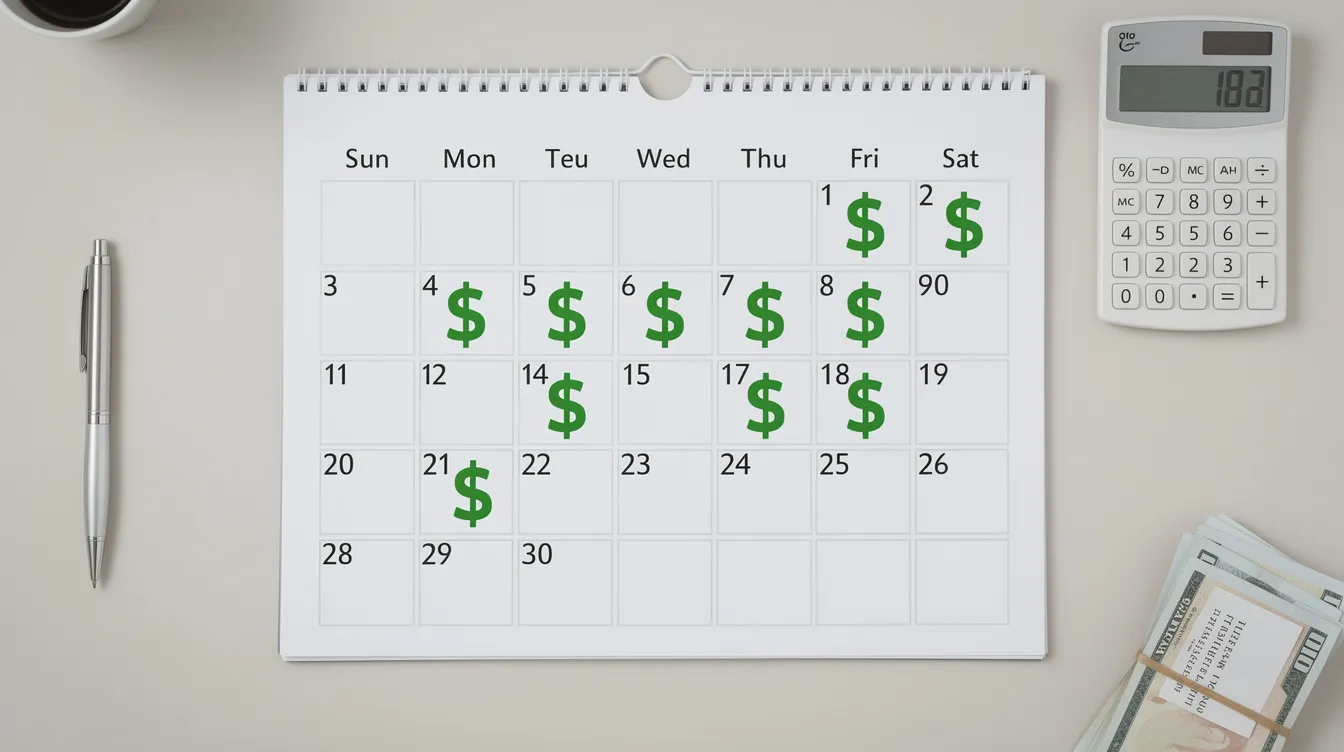
Changing payment frequency (not just amount) cuts interest because HELOC interest is calculated on the daily balance. A lower average balance means less interest accrues.
Biweekly approach: Pay half your target monthly payment every two weeks. Bi-weekly payments result in 26 half payments a year, equalling 13 full payments instead of 12. That extra payment each year quietly chips away at principal without you feeling the pinch.
Paycheck sweep approach: Each time income hits your bank account, automatically sweep a portion (10 to 30%) straight to the HELOC before it gets spent elsewhere. This is simpler and safer than extreme velocity banking schemes.
The key rule: keep one month of operating expenses in checking for bills and only sweep true surplus. If you sweep too aggressively, you'll be forced to re-borrow from the revolving line immediately, erasing the benefit.
One month example:
| Date | Event | HELOC Balance |
|---|---|---|
| 1st | Payday, sweep $800 to HELOC | $41,200 |
| 8th | Regular bills clear checking | $41,200 |
| 15th | Payday, sweep $800 to HELOC | $40,400 |
| 22nd | Bills clear | $40,400 |
| 30th | Same payment as standard minimum | $40,100 |
The average daily balance across the month is noticeably lower than if you'd made one lump payment on the 30th. Over 12 months, you pay less interest and reduce principal faster.
When to Refinance the HELOC or Convert to a Fixed Home Equity Loan
If interest rates rise sharply, or you're approaching the end of your draw period with a large balance still owed, refinancing or converting to a fixed rate home equity loan can stabilise your monthly payments and make a payoff plan predictable.
Scenarios where a home equity loan makes sense:
- HELOC balance between $50,000 and $150,000
- You expect variable interest rates to keep climbing
- You want fixed monthly payments over 5 to 20 years
Many lenders allow you to convert a variable HELOC balance into a fixed rate loan, sometimes as a partial conversion within the same credit facility. Consolidation or refinancing can help manage high interest debts and remove the guesswork from budgeting.
Key trade-offs: You lose flexible access to a revolving line of credit but gain certainty on rate and amortisation. Closing costs typically run 2% to 5% of the loan amount, so calculate your break even point before committing. If you're saving $200 per month in interest but paying $3,000 in fees, you need 15 months just to recoup the cost.
The difference between a traditional second position home equity loan and replacing your whole mortgage with a first lien HELOC is significant. Some investors like first lien HELOCs for flexibility, but they still carry variable rate risk and borrowing costs that can spike.
Before refinancing, compare options with your existing lender and at least one other source. Make sure the all in lower rate and fees truly improve your situation vs just extending the debt.
Beware of "Velocity Banking" and Aggressive First Lien HELOC Schemes
Velocity banking promises you can use a HELOC to pay off your mortgage faster by running all income and expenses through the HELOC, effectively using it as your primary bank account and mortgage replacement. Sounds clever. Often isn't.
Here's the problem in plain English: using a HELOC to pay off a lower interest mortgage can increase total interest paid. If your mortgage sits at 4% and your HELOC charges 8%, you're paying more interest on every dollar you shift across. The compound interest maths only works in your favour if your HELOC rate is meaningfully below your mortgage rate and you have strong positive monthly cash flow to crush the balance quickly.
Simple example: Moving $100,000 from a 4% mortgage onto an 8% HELOC increases your annual interest cost from $4,000 to $8,000. Unless you're throwing a fair whack of surplus income at it each month, you'll pay more interest overall, not less. HELOC interest rates are typically variable and can increase, making the gamble worse over time.
The core benefit of these systems usually comes from making extra payments, not from the HELOC structure itself. Most people can achieve similar or better payoff results by just sending extra payments directly to the mortgage and HELOC without the complexity. Paying off a mortgage with a HELOC requires careful financial planning, and I reckon most of the "coaches" selling $2,000 velocity banking courses aren't doing that planning for you.
Smart Uses of HELOC Funds While You're Paying It Down
If you're a real estate investor or entrepreneur, you probably still want to use your home equity line for productive purposes while paying it off. That's fine, as long as you're strategic about it.
High value uses that can justify the interest cost:
- Targeted home improvements that materially increase your property's value. Using a HELOC can fund home improvements like adding a bedroom or updating a kitchen. Home improvements can increase your home's value significantly, sometimes returning 70% to 100%+ of the spend.
- Funding a profitable fix and flip with a clear exit strategy and timeline.
- Consolidating higher interest debt: using a HELOC to pay off $25,000 of credit card debt at 24% APR, then aggressively paying down the HELOC over 2 to 4 years, reduces both interest and complexity.
Poor uses: holidays, depreciating vehicles, or speculative investments without a tested track record. Overborrowing on a HELOC can lead to excessive debt with your house on the line.
Quick tax note: HELOC interest used for home improvements that substantially improve the property may be tax deductible under current IRS rules. Interest on HELOC used for personal spending generally is not. Consult a tax professional for your specific situation. I'm not a CPA, and Anthony Rushing (our operations lead) will be the first to remind me of that.
Closing the Funding Gap: How Gap Funded Can Help You Pay Off HELOCs Faster
Once you understand the right payoff order and strategy, you may still hit a wall: not enough cash to handle down payments, rehab, or working capital while also paying down your HELOC aggressively. That's the funding gap, and it's where we come in.
Gap Funded specialises in filling that gap so investors and business owners don't have to overdepend on a single HELOC or drain their home equity just to keep deals moving. Here's how our tools map to faster HELOC payoff:
- Debt consolidation: Move high interest revolving balances into structured, lower rate payments. When you're paying less interest on credit cards and personal loans, you free up real money to redirect at your HELOC principal each month.
- 0% credit card stacking: Secure working capital for flips, BRRRR projects, or a new business launch at 0% intro APR so you're not re-drawing your HELOC for every expense. Your HELOC balance can actually fall instead of bouncing back up.
- Gap funding: Unsecured term loans for down payments, earnest money, or reserves without taking a lien on your deal property.
Order matters. First, consolidate and reduce higher interest debt to free monthly payments. Second, secure short term, lower cost capital for projects so your HELOC balance trends downward. Third, redirect freed up cash toward structured extra payments on the HELOC and eventually the mortgage.
Typical qualification: FICO roughly 650+, stable income or verifiable revenue, and usable home equity or strong credit profile. We run soft credit pulls with no impact to your score just to check your options. No obligation, no pressure.
Apply for a free funding review here and we'll map out a realistic plan to get your HELOC paid off years sooner without stalling your investments or business growth.

Final Thoughts: Balancing Speed, Safety, and Opportunity
Paying off a HELOC faster comes down to intentional extra payments, smart debt prioritisation, and avoiding high risk schemes. Not financial tricks, not magic software, not some bloke on YouTube telling you to put your entire mortgage on a credit line.
Here's the short version:
- Know your exact draw period and repayment terms.
- Attack higher interest debt first, then systematically reduce your HELOC principal.
- Consider refinancing to a fixed home equity loan only when the maths and fees clearly help.
- Keep enough liquidity so you don't need to run balances back up again.
Run your own numbers with realistic assumptions about your income, expenses, and market conditions. If the main obstacle is a funding gap (down payments, rehab, working capital, or consolidating higher interest debt), Gap Funded can help build a tailored capital stack so you can both keep investing and become debt free on a predictable timeline.
Related Reading
This article is for educational purposes only and isn't financial, legal, tax, or investment advice. Credit and financing outcomes depend on your own situation. Talk to a licensed financial professional before making funding decisions for your business.