
House Flipping vs Renting: Which Strategy Fits Your Real Estate Goals (and How to Actually Fund It)?

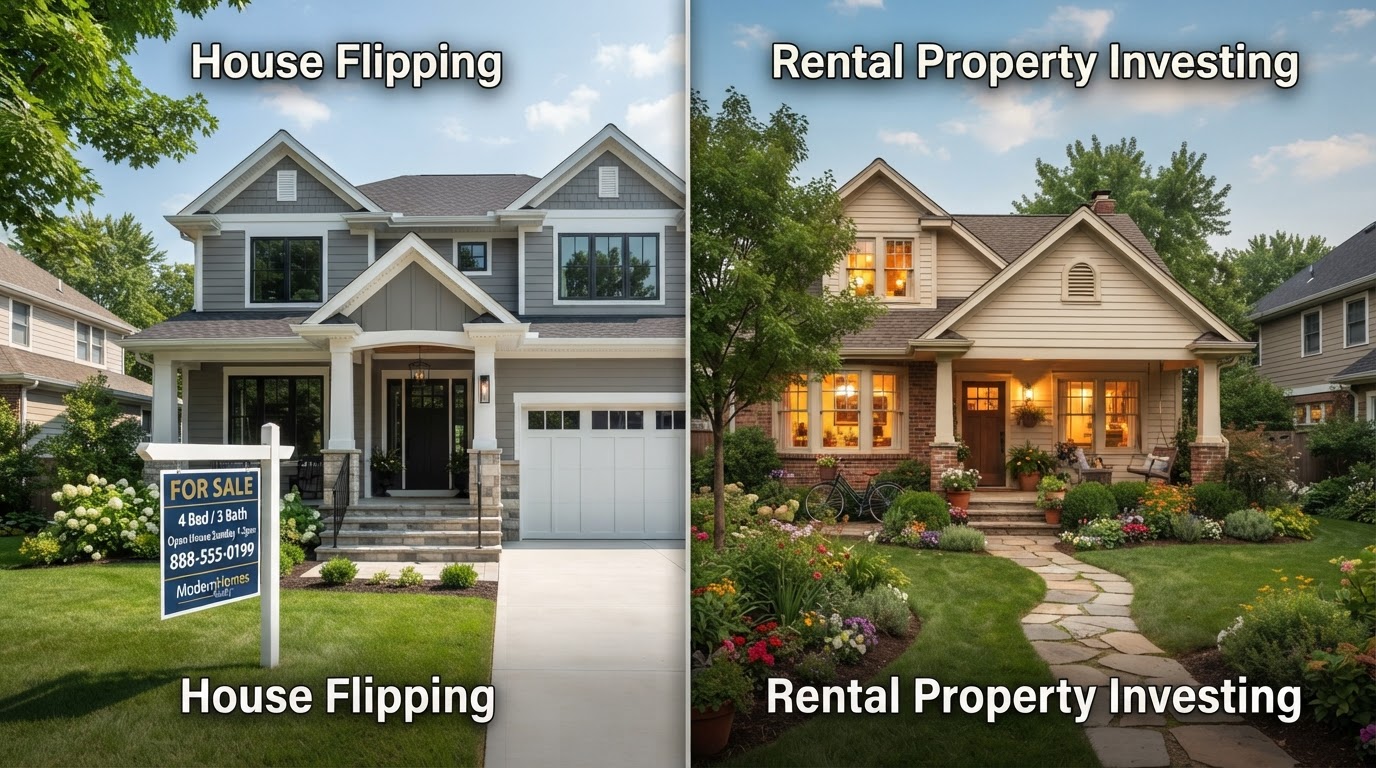
House Flipping vs Renting: The Short Answer for Investors
Most investors debating house flipping vs renting are really asking a deeper question: should I chase a big payday now or build wealth that compounds over decades? The honest answer is that neither real estate investment strategy is universally superior-they solve different problems, and the right choice depends on your time horizon, risk tolerance, and access to capital.
Renting is typically the stronger path for long-term wealth-building. Rental properties deliver recurring monthly cash flow, tax advantages through depreciation and mortgage interest deductions, and equity growth as tenants pay down your mortgage. Over a 10- to 30-year hold, a well-bought rental property investment can outperform most flips on an after-tax, risk-adjusted basis. Flipping houses, on the other hand, wins when you need to generate a large lump sum quickly-to pay off debt, fund a down payment on your next deal, or build a cash reserve. It's active income, though: high effort, high variance, and taxed at ordinary income rates.
The single biggest deciding factor is the combination of your time horizon, your comfort with risk, and whether you can actually fund the deal. That last piece-capital-is where most strategies fall apart on paper. Gap Funded works as a funding partner that helps real estate investors bridge shortfalls in down payments, rehab budgets, closing costs, and reserves without giving up deal equity, so you can actually execute whichever strategy fits your goals.
What Is House Flipping in Today's Market?
House flipping means buying a distressed or undervalued residential property, adding value through renovation, and reselling it within a short window-typically 3 to 12 months-for a profit. It's a real estate strategy built on speed, precision, and market timing.
Here are the defining traits of flipping in today's market:
- Active income model. Flipping functions like an active project management job involving contractors and quick turnarounds. House flipping produces active, one-time earned income per completed project-when you stop doing deals, the income stops.
- Dependence on after-repair value (ARV). Your entire profit margin hinges on accurately estimating what the property will sell for after rehab. Get the ARV wrong and renovation costs can quickly erode profits.
- Sensitivity to holding costs. Every extra week on the timeline means more interest, property tax, utilities, and insurance eating into your net profit. Monthly carrying costs on hard money loans are not forgiving.
- Market timing risk. House flipping carries high market timing risks during renovations-a shift in buyer demand or a rate hike mid-project can compress margins or eliminate them.
Typical flip timelines run about 165 days nationally as of early 2026, though experienced flippers doing cosmetic rehabs can close in 3–5 months while heavier projects or first-time operators often stretch past 9 months. Average flipping profits hover around 35% of the purchase price before expenses, and successful flips can yield $20,000–$40,000 per deal in many markets. ATTOM data showed median gross profit of roughly $70,000 per flip in Q2 2024, though ROI before expenses dropped to about 28.7% by Q3 2024 as margins compressed.
Common financing structures include hard money loans, bridge loans, and private money. But here's the reality: primary lenders typically finance 65–80% of purchase price or ARV, which means they rarely cover 100% of purchase plus rehab plus holding costs plus closing. That uncovered portion-the funding gap-is where deals stall or die.
What Is Renting / Buy-and-Hold Real Estate?
Renting, or buy-and-hold real estate investing, means purchasing an investment property to generate recurring rental income over years or decades while building equity through mortgage paydown and property appreciation. The rental strategy focuses on maximizing historical appreciation and cash flow rather than quick capital returns.
The defining traits of this approach:
- Passive or semi-passive income. Renting generates consistent, monthly passive cash flow from tenants paying rent. Investors can earn passive income by hiring property management, making it closer to a passive investment than flipping.
- Equity build through amortization. Long-term renting builds wealth as tenants pay down mortgage principal-you're building equity with someone else's money.
- Long-term appreciation. Real estate typically appreciates in value over time, and real estate assets generally retain or grow value during inflationary periods, providing built-in inflation protection.
- Leverage-friendly. Conventional mortgages, DSCR loans, and portfolio products let you control more property with less cash, and investors can accumulate properties with renting, unlike flipping which is project-based.
This category includes traditional long-term rentals, the BRRRR method (Buy, Rehab, Rent, Refinance, Repeat), and short-term rentals like Airbnb. Typical holding periods range from 5 to 30+ years. Cash-on-cash return targets in many U.S. markets have historically been 8–12%, though with elevated interest rates in 2026, averages have dropped to 2–5% for many conventionally financed deals. Short-term rentals can target 8–20%+ cash-on-cash returns in favorable markets, but come with more volatility and hands-on work.
Professional property management plays a major role here. Rental property investors often hire management companies for tasks like tenant screening and maintenance requests, with management fees typically running 8–10% of rent. That cost is usually tax deductible and buys you genuine semi-passive ownership.
House Flipping vs Renting: How They Compare at a Glance
Before diving into each decisive factor, here's a side-by-side look at how these two strategies stack up across the dimensions that actually drive the decision.
| Factor | House Flipping | Renting / Buy-and-Hold |
|---|---|---|
| Best for | Investors who want lump-sum profits in months; strong rehab/project skills; high risk tolerance | Investors seeking steady income, long-term wealth, lower risk, semi-passive involvement |
| Typical timeline | 4–9 months from purchase to sale | 5–30+ years to maximize equity, appreciation, and tax benefits |
| Income type | Lump sum after sale; no income during rehab | Monthly cash flow from rents; grows with rent increases and mortgage paydown |
| Capital needs | Down payment (10–25%), closing, rehab budget, holding costs, staging, contingency | Down payment (20–25%), closing, rehab to rent-ready, reserves, furniture for STRs |
| Financing options | Hard money, bridge loans, gap funding, private money | Conventional/DSCR loans, portfolio loans, BRRRR refinancing, HELOCs |
| Risk level | High: cost overruns, market shifts, carrying cost exposure, funding risk | Moderate: vacancy, tenant issues, maintenance, regulatory changes |
| Time & effort | Very high: daily/weekly project management, contractor oversight, exit execution | Moderate: tenant placement, lease oversight; can outsource most tasks |
| Tax treatment | Short term capital gains or ordinary income (24–37%+ federal); limited deductions | Depreciation over 27.5 years; deductible expenses; 1031 exchanges; lower effective rates |
The biggest takeaway: neither strategy is "better" universally. The primary goal of flipping is capital appreciation while renting aims for cash flow. They're different tools suited to different financial goals and constraints-and the smartest investors often use both at different stages.
Decisive Factor #1: Time Horizon & Income Pattern
The shape of your returns-when and how money actually hits your bank account-is usually the first filter that separates which investment path makes sense.
Flipping produces income in bursts. House flipping operates on a short cycle, typically 3 to 6 months, with all the profit arriving as a single lump sum at closing. Between deals, income is zero. This makes flipping more like running a business than owning an asset: if you don't actively do deals, you don't get paid. But for investors who want to build cash quickly-to pay off high-interest debt, fund down payments on rental properties, or stack capital for larger acquisitions-this concentrated payout structure is powerful.
Renting delivers recurring monthly income that can grow over time. Cash flow may start modestly-perhaps $300–$600 per month net per door in mid-tier markets-but renting compounds wealth via tenant-funded mortgage paydown and property appreciation. Over a decade, rents rise, mortgages shrink, and property values rise. Rental income can be used for retirement or education funds, making it a natural fit for building wealth across generations.
Consider a simple 2026 comparison. A flip: purchase at $200,000, rehab $50,000, holding and closing costs $20,000, resale at $300,000. Net profit before tax: roughly $30,000 over six months. Now take that same $200,000 property as a rental: 25% down ($50,000), monthly rent $1,800, net operating income after mortgage, taxes, and expenses approximately $400/month-$4,800/year in cash flow. Modest at first. But over 10 years, you've collected roughly $48,000 in cash flow, paid down significant mortgage principal, and likely gained 30–40% in property appreciation. The rental offers steady income that snowballs; the flip offers a faster but one-time hit.
Winner for long-term wealth-building: Renting. The compounding of appreciation, mortgage paydown, and growing rents is hard to beat over time. Winner for near-term lump-sum cash generation: Flipping. Nothing else in real estate investing puts $20,000–$50,000 in your pocket in under six months.
Decisive Factor #2: Risk Profile & Market Exposure
Risk tolerance and market exposure in 2024–2026-with elevated interest rates, volatile construction costs, and shifting local demand-heavily influence which strategy is safer for your situation.
Flipping carries substantial risks. You're exposed to short-term price swings: if rates rise mid-project, your buyer pool shrinks and days on market stretch. Renovation risk is constant-hidden structural damage, permit delays, and contractor no-shows can turn a $50,000 rehab into a $75,000 nightmare. Carrying costs on hard money (often 10–14% annual rates) mean every extra month on the timeline directly erodes your margin. And margins are under pressure: as of Q3 2025, 41% of flippers report typical margins of only 20–29%, well below the pre-2020 glory days. Zillow lost over $500 million in a house flipping venture, proving that even well-resourced operations can make such a costly mistake when market timing goes wrong. Flipping houses can lead to significant financial loss when multiple additional profit draining challenges stack up at once.
Renting's risks are different-and generally more manageable. Rental properties can face vacancies, impacting cash flow, and landlords face responsibilities such as handling maintenance and tenant issues. Non-paying tenants, regulatory changes like rent control or STR restrictions, and major capital expenditures (roof, HVAC) are real concerns. But rental income is rent-driven and can weather flat or mildly down markets because people always need housing. And rental property owners have flexibility to adjust: convert to a mid-term rental, refinance into better terms, or simply wait out a soft cycle while collecting rent.
The risk profiles suit different investors. Experienced, full-time operators with strong contractor networks and buffer capital can handle flipping's variance. Conservative, long-term planners-or anyone who loses sleep over variable income-will find renting far more resilient.
Winner for higher-risk, higher-variance upside: Flipping. If you can stomach the volatility and have the skills, the payoff per deal is larger. Winner for lower-risk, more resilient income: Renting. Rental real estate absorbs market shocks better and lets you ride out downturns.
Decisive Factor #3: Time & Skill Requirements
The "passive vs active" distinction between flipping and renting is often misunderstood-neither is truly hands-off-but the intensity gap between them is real and should be a core factor in your decision.
Flipping is a full-time commitment. Active management is more intensive in house flipping compared to renting. The workload spans every phase of the deal:
- Deal sourcing and negotiation: Finding properties below market value in your local real estate market requires speed, relationships, and analytical skill.
- Scope of work and project management: Planning rehab budgets, selecting materials, hiring and managing contractors, handling inspections, pulling permits, and managing change orders-often on a daily or weekly basis.
- Exit execution: Staging, listing, negotiating with buyers, handling inspection repair requests, and closing. Every delay costs money.
Flipping requires significant upfront investment and time commitment. Managing house flipping can be labor-intensive and stressful. If you don't enjoy construction logistics and fast-moving decisions, this workload will wear you down.
Renting demands less ongoing intensity-especially with the right systems. The upfront work is meaningful: underwriting deals, securing financing, completing rehab to rent-ready standard. But ongoing tasks-tenant placement, lease management, rent collection, maintenance requests-can largely be outsourced. Property management handles tenant screening and maintenance requests for that 8–10% fee. Renting properties requires periodic maintenance and tenant oversight, but it's predictable and schedulable.
Short-term rentals are a notable exception: guest turnover, cleaning coordination, dynamic pricing, and amenity management push STRs closer to an active business, though still without the construction risk of flips.
Both strategies require education and systems, but flipping is inherently closer to running a small construction business, while renting is closer to managing assets. That's not a trivial difference-it determines whether real estate investing fits into your life or consumes it.
Winner for people with limited time or desire to manage projects: Renting. Especially long-term rentals with professional property management. Winner for full-time operators with strong rehab skills: Flipping. Your expertise directly translates to higher margins.
Decisive Factor #4: Capital, Financing & the "Funding Gap"
Access to capital-and its cost-often decides what's realistically possible, regardless of which strategy looks better on a spreadsheet. In 2024–2026, with mortgage rates elevated compared to the 2010–2021 era and lenders tightening requirements, this factor has become even more decisive.
Flipping's typical funding stack and gaps:
Hard money or bridge loans typically cover 60–80% of purchase price or ARV, but rarely fund 100% of the total cost. The investor is expected to bring:
- Down payment (often 10–25% of purchase price)
- Unfinanced rehab costs, especially initial draws before lender reimbursements
- Closing costs (2–4%)
- Holding costs during rehab (interest, property tax, insurance, utilities)
- Contingency reserves for cost overruns
House flipping has high capital requirements for purchase and renovation. These "gaps" between what lenders provide and what deals actually cost are where many flippers either bring in equity partners (sacrificing profit), drain personal savings, or learn how to fund a fix and flip with little or no money out of pocket instead of simply losing deals.
Renting / BRRRR funding stack and gaps:
Conventional or DSCR financing typically requires 20–25% down for an investment property-higher for non-owner-occupied multifamily. Beyond that, landlords need sufficient cash reserves to handle unexpected expenses during renting, and they should understand what you actually need to qualify for gap funding if they plan to bridge these shortfalls.
- Closing costs
- Rehab to get units rent-ready
- Furniture and amenities for STRs
- 3–6 months of reserves for vacancy and major maintenance
- Working capital during lease-up when rents haven't stabilized
How Gap Funded closes these gaps:
Gap Funded provides capital products designed to cover exactly these shortfalls-without taking equity in your deal or placing liens on the subject property for many products:
- Unsecured personal term loans for down payments, closing costs, and rehab-deployed in 24–72 hours, with loan amounts ranging from $20,000 to $120,000+ depending on profile.
- 0% introductory APR business credit card stacking for materials, labor draws, staging, and STR furniture. This revolving credit is flexible and powerful but requires disciplined repayment before promotional periods end.
- HELOCs on existing properties for investors with equity but limited cash-useful as a revolving rehab and reserve line and for unlocking home equity through investor-focused HELOC loans.
- Business lines of credit and working capital solutions to stabilize cash flow for active flippers running multiple properties or landlords managing larger rental portfolios.
Realistic qualification: typical minimum FICO is 650+, with stronger options at 680–720+. Verifiable income or business revenue, or usable equity in real estate, strengthens approvals. An investor with $90,000 annual income and a 710 FICO might access $36,000–$45,000 in term loans, stacked with credit cards or other tools to reach $60,000–$120,000 in total gap funding. Even new investors under two years in business can often qualify for consumer-based funding tools before they're eligible for standard business credit lines. Gap Funded uses soft credit pulls initially, so you can see options without impacting your score.
The key distinction: Gap Funded isn't replacing your hard money or DSCR loan. It's stacking on top to cover the shortfalls that would otherwise force you to bring in equity partners or give up a share of the deal.
Winner on pure capital efficiency once you've built equity: Renting/BRRRR-refinancing pulls capital back out, and the cycle repeats. Winner on leveraging other people's money for short bursts: Flipping-especially when paired with targeted gap funding that keeps you from stalling on capital-intensive projects.
Decisive Factor #5: Taxes, Wealth-Building & Exit Options
After-tax returns and exit flexibility matter more than headline profit numbers. A $50,000 gross flip profit and $50,000 in cumulative rental income over several years are taxed very differently-and that gap compounds over time.
Flipping tax treatment:
Profits from house flipping are generally taxed as ordinary income. If you're flipping as a business (which most active flippers are), your gains are typically classified as short-term capital gains or dealer income-taxed at your ordinary federal rate, often in the 24–37%+ brackets, plus state taxes. That can mean handing over 30–40% of your profit to taxes. There's no depreciation benefit because you don't hold the property long enough to qualify. While 1031 exchanges are sometimes possible, most flips treated as inventory don't qualify, limiting your ability to defer capital gains taxes.
Renting tax treatment:
Rental property owners enjoy significantly more favorable tax treatment. You can depreciate the building structure over 27.5 years, reducing taxable income substantially without any cash outlay. Rental property owners can deduct expenses like repairs and maintenance, mortgage interest, property tax, management fees, insurance, and travel. Depreciation can save rental property owners thousands in taxes annually, and cost segregation studies on larger deals can accelerate those benefits further. When you eventually sell, long-term capital gains rates (0%, 15%, or 20% depending on income) apply-far lower than ordinary income rates. And 1031 like-kind exchanges let you defer taxes entirely when trading up to larger properties or consolidating your portfolio. These special tax benefits make rental property investment one of the most tax-advantaged wealth-building vehicles available.
Exit flexibility:
Flips usually have a single planned exit: sell after rehab. If the sale market softens-say you're caught in a buyer's market-the plan can be forced at a lower price or profits can be crushed. Exit options are constrained by design.
Rentals offer multiple viable exits: continue to hold and collect rent, refinance to pull cash out, convert between long-term, mid-term, or short-term rental strategies, or sell when market conditions favor a seller's market. You can also pass rental real estate to heirs, who receive a stepped-up cost basis. This flexibility is a significant advantage when market conditions shift unexpectedly.
Winner for long-term, tax-advantaged wealth building: Renting. The combination of depreciation, deductible expenses, lower capital gains taxes on sale, and 1031 exchanges creates a compounding advantage that flipping simply cannot match. Winner for short-term, pre-tax cash generation: Flipping. The gross returns per deal are higher-you just keep less after taxes.
How to Decide: Should You Start With Flipping or Renting?
There's no universal best investment path. The smart investment choice is the one that aligns with your financial goals, skills, timeline, and stress tolerance-not whatever strategy is trending on social media.
Choose flipping if:
- You want to build a large cash cushion in the next 12–36 months
- You have time to manage contractors or a background in construction and design
- You're comfortable with higher risk, variable income, and fast-moving decisions
- You have (or can access via Gap Funded) enough capital for down payment, rehab, and holding costs on active projects
- You understand your local real estate market well enough to estimate ARV with confidence
Choose renting / BRRRR if:
- You want durable, semi-passive monthly income and long-term equity growth
- You prefer lower volatility and can commit to holding assets for 5–10+ years
- You're okay with modest early returns in exchange for compounding over time
- You have or can access capital for down payments, closing costs, and reserves
- You're comfortable underwriting cash flow and managing (or outsourcing) tenant relationships
Do both over time:
- Use early flips, fueled by gap funding, to build the cash needed for 20–25% down payments on rentals
- Transition gradually to a portfolio where flip profits are icing and rental income is the base
- This blended approach lets you generate income through flipping while building long term growth through rentals
Map your real estate strategy to your personal goals, not someone else's highlight reel. The investor who flips three houses in year one to fund two rental acquisitions in year two isn't following a formula-they're building a strategy that fits their life.
How Gap Funded Helps Flippers & Landlords Close Their Funding Gaps
Every real estate deal has a capital stack: the combination of debt, equity, and cash that covers the total cost. The problem is that hard money lenders, DSCR lenders, and banks fund a portion-typically 60–80% of purchase or ARV-leaving the investor to cover the rest. That uncovered portion (down payment, closing costs, rehab overages, reserves) is the "gap," and it's where most investors either stall, overpay for capital through costly options like second lien gap funding, or give up equity they shouldn't have to.
For Flippers
Typical shortfalls include 10–25% down payments, closing costs (2–4%), initial rehab draws before lender reimbursements, staging and marketing expenses, earnest money deposits that need to be wired quickly, and additional holding costs if days on market stretch beyond projections.
Gap Funded tools can be sequenced strategically:
- Unsecured personal term loans first-to cover down payment and closing costs quickly, often funded within 24–72 hours so you don't miss tight closing timelines.
- 0% introductory APR business credit card stacking next-to finance materials, labor draws, and project incidentals with flexible, revolving credit.
- HELOCs on existing properties as a third layer-for experienced investors with equity who need a safety net for overages or want to run multiple deals simultaneously.
Key benefits: no equity splits with partners, no liens on the subject property for many products, soft credit pulls to check options, and rapid execution that matches the speed flipping demands.
For Rental / BRRRR Investors
Common gaps include 20–25% down payments for DSCR or conventional loans, rehab costs to get units rent-ready, furnishing short-term rentals, initial vacancies and lease-up costs before regular income stabilizes, and emergency reserves.
Recommended order of tools:
- Personal term loans or HELOCs to fund the bulk of down payment or major rehab-these provide the largest capital amounts upfront.
- 0% APR credit card stacks for furniture, light renovations, and operating expenses during lease-up-ideal for STR investors furnishing multiple properties.
- Business lines of credit as the portfolio grows-smoothing cash flow across several rental properties and covering large but short-lived cash needs without disrupting operations.
The critical discipline: underwrite your deals so that post-refinance cash flow realistically covers any new payments from gap funding. Overleveraging is a risk with any form of financing.
Realistic borrower profile: Typical FICO 650+ (stronger options at 680+), verifiable income or business revenue, or usable equity in real estate. Even new investors under two years in business can often qualify for consumer-based funding before they're eligible for standard business credit lines.
Ready to see what you qualify for? Complete a quick application at gapfunded.com/apply for a personalized capital stack review for your next flip or rental acquisition-soft pull only, no impact to your credit.
House Flipping vs Renting: Example Scenarios Using Gap Funding
These simplified scenarios illustrate how each strategy-and the funding behind it-looks in practice for different investor profiles.
Scenario 1: New Investor with W-2 Income, 690 FICO, Limited Savings
Flip path: A $250,000 distressed property in a secondary metro with a $60,000 rehab. Total cash needed beyond the hard money loan: roughly $50,000 for the 20% down payment, plus closing costs and initial rehab draws. Gap funding could supply $20,000–$40,000 via a term loan plus credit card stacking for rehab materials. Exit in approximately six months with a gross profit of $30,000–$50,000 before tax. The risk: flipping requires significant upfront investment and time commitment, and this investor is learning on the job.
Rental path: A $220,000 single-family rental renting at $1,900/month. Down payment at 25% is roughly $55,000, plus closing costs and $10,000–$15,000 in light rehab to get rent-ready. Net cash flow after expenses and mortgage: roughly $300–$600/month. Gap funding could cover part of the down payment and rehab to avoid draining savings entirely. The trade-off: slower returns, but rental properties provide consistent cash flow and long-term appreciation with far less active stress.
Scenario 2: Experienced Contractor, Multiple Flips, Little Liquidity but Equity
This investor knows construction but has capital tied up in existing properties. By using HELOCs on a primary residence and existing rentals, plus card stacking for materials and a term loan for earnest money deposits and reserves, they could run two flips and one BRRRR acquisition in the same 12-month period. The management concern here is risk concentration: maintaining adequate reserves across multiple properties and not overleveraging despite increased deal capacity. Discipline matters more than ambition at this stage.
Scenario 3: Small Landlord with 3 Rentals Looking to Scale
This property owner has steady rental income from three doors but needs capital to keep growing. Two viable paths:
- Option A: Acquire more rentals via BRRRR, using refinancing to recycle capital from existing properties and gap funding to cover the next down payment.
- Option B: Complete one or two flips to generate additional cash for down payments on future rentals-using the flip as a capital-building engine rather than a permanent strategy.
In both cases, a combination of unsecured loans and business credit lines can speed up acquisitions without bringing in equity partners, keeping profit shares and control intact.
House Flipping vs Renting: Final Verdict
Flipping is best treated as an active business for generating income quickly. Successful house flips can yield large lump-sum profits, and the strategy shines when you have the time, skill, and capital buffers to manage renovation risk. But the tax drag is real-profits are taxed as ordinary income-and flipping may have higher operational costs and risk compared to renting. Without disciplined underwriting and adequate reserves, potential profits can evaporate.
Renting, especially via BRRRR or traditional long-term holds, is the stronger path for building durable, tax-advantaged wealth. Renting offers recurring income while potentially increasing property value over time. Monthly income grows as rents increase and mortgages are paid down. The tax benefits-depreciation, deductible expenses, 1031 exchanges-make rental property investment one of the most efficient vehicles for building wealth in real estate.
The combined strategy is where many successful investors land: use early flips, fueled by gap funding, to generate the capital needed for 20–25% down payments on rentals. Over time, flip profits become occasional bonuses while rental income forms the foundation of your portfolio-a base of regular income and property appreciation that compounds year after year.
Who should lean which way:
- Beginners who need capital fast: Start with small, cosmetic flips to build your bankroll and learn the market.
- Investors who prioritize stability: Go directly into rentals or BRRRR if you have some capital and patience.
- Investors with both ambition and capacity: Blend strategies from the start, using gap funding tools to execute more deals without sacrificing equity.
Whatever your investment strategy, the gap between "deal that works on paper" and "deal that actually closes" is almost always a capital gap. Get a free funding review at gapfunded.com/apply to see real numbers for your market and strategy-soft pull only, no impact on your credit for initial options.
Frequently Asked Questions About House Flipping vs Renting
Is it easier to get financing for a flip or a rental property?
Conventional and DSCR lenders generally prefer stable rental properties because the ongoing rental income supports the loan. Underwriting is strict-expect 20–25% down and reserve requirements for any investment property-but the process is well-established. Flips typically rely on hard money or private lending, which can be faster to close but more expensive and shorter-term. Many flip deals don't make financial sense without gap capital to cover what primary lenders won't fund. Gap funding can make either strategy feasible when the main blocker is cash for down payment, rehab, or reserves.
Can I use Gap Funded capital for both flipping and rentals at the same time?
Yes. Tools like term loans, credit card stacking, and HELOCs can be deployed across multiple deals simultaneously, as long as total payments are sustainable relative to your income and deal cash flows. A practical approach: use 0% APR cards for faster flips or STR furniture where the promotional period aligns with your timeline, and use term loans for larger, longer-duration needs like down payments and rehab on rentals.
What credit score do I need to qualify for gap funding for real estate deals?
Typical minimum FICO is around 650, with preferred ranges of 680–720+ for the best approvals and terms. Income, current debt levels, and recent credit behavior also factor in. Gap Funded uses soft pulls initially, so applicants can see their options without any impact to their credit score.
Is it smarter to flip first and then buy rentals, or go straight into buy-and-hold?
It depends on your starting position. The flip-first path makes sense if you need to build capital fast and can handle the risk and time demands of active project management. The rental-first path is better if you prioritize stability, have some savings to deploy, and can be patient with modest early returns. A hybrid path-small early flips or a BRRRR deal plus ongoing accumulation of rentals-works well for investors who want to build generating income capacity while simultaneously creating long term growth. Align with your personal skills and stress tolerance rather than copying someone else's strategy.
What's the worst-case scenario with each strategy and how do I protect myself?
For flips: a big over-budget rehab combined with a softening market can turn expected profit into a break-even or outright loss. Holding costs snowball, and what looked like a profitable deal becomes such a costly mistake. Protect yourself with conservative ARV estimates, 15–20% contingency in your rehab budget, realistic timelines, and strong contractor relationships.
For rentals: extended vacancy, non-paying tenants, or a major capital repair (roof, foundation, HVAC) without reserves can strain cash flow badly. Landlords need sufficient cash reserves to handle unexpected expenses during renting. Protect yourself with thorough tenant screening, adequate insurance, conservative rent projections, a maintenance schedule, and at least 3–6 months of reserves per property. For either strategy, don't overlever with any form of financing-including gap funding.
How do I know if a specific deal works better as a flip or as a rental?
Run the numbers both ways. Calculate projected flip profit: sale price minus purchase price, renovation costs, holding costs, closing costs, and taxes. Then calculate projected rental metrics: cash-on-cash return, debt service coverage ratio, and long-term appreciation potential for the same property. A strong rent-to-price ratio and stable neighborhood favor rentals. A large ARV spread with strong buyer demand in the local real estate market favors flips. Consider running both scenarios with a funding advisor at Gap Funded to see how different capital stacks affect your net returns in each case.
Related Reading
This article is for educational purposes only and isn't financial, legal, tax, or investment advice. Credit and financing outcomes depend on your own situation. Talk to a licensed financial professional before making funding decisions for your business.