
HELOC vs 401(k) Loan: Which Is Better for Real Estate Investors and New Business Owners?

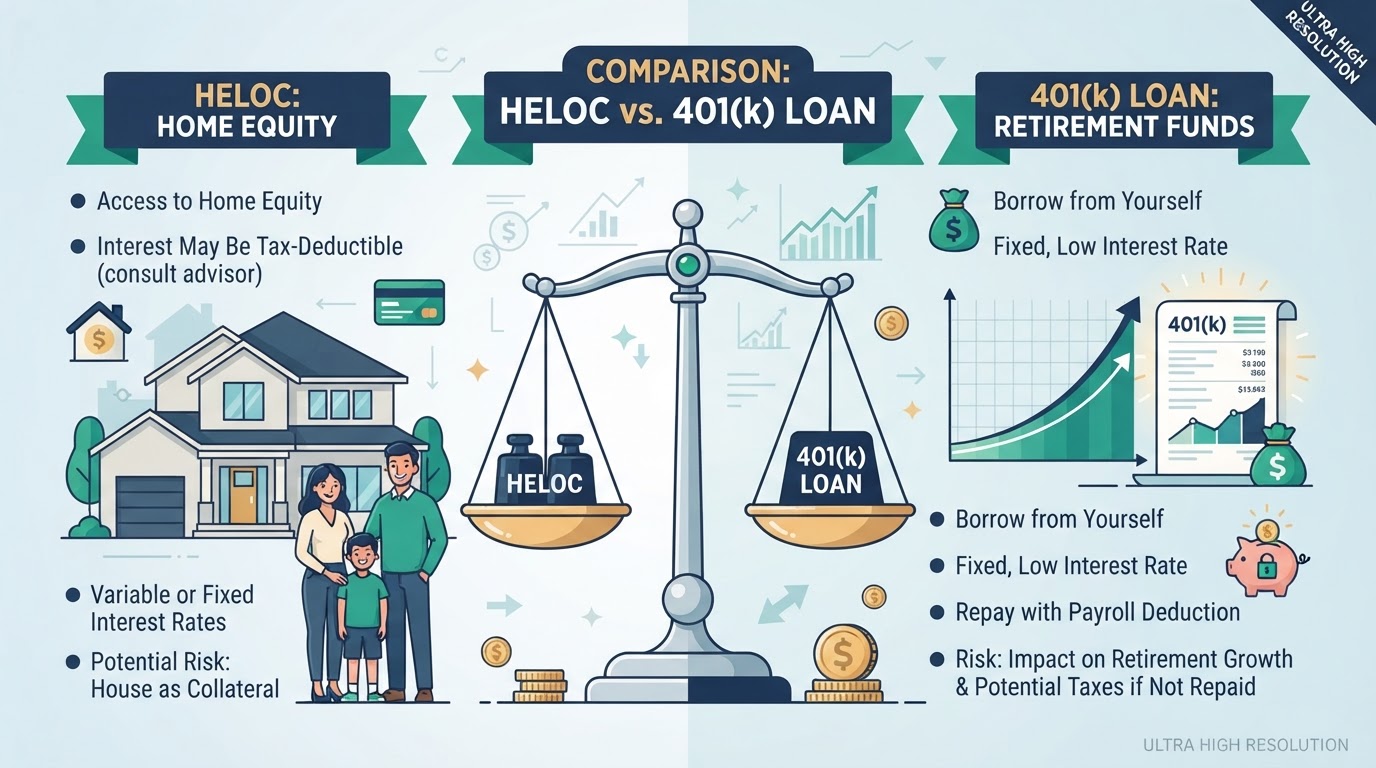
If you're weighing a HELOC vs 401(k) loan to fund a fix-and-flip, a BRRRR rental, a short-term rental build-out, or a new business launch, the core question is straightforward: do you want to put your property on the line, or your retirement growth? Both HELOCs and 401(k) loans let you borrow money you already have a financial connection to, but they differ in loan amount caps, repayment terms, risk exposure, and flexibility in ways that change the math for every deal.
For most real estate investors and new business owners who need capital for down payments, rehab budgets, earnest money deposits, working capital, or debt consolidation, one option tends to outperform the other. The deciding factors are how much equity you hold, how stable your employment is, and how many deals you plan to run over the next few years.
The short answer: A home equity line of credit is the stronger primary funding tool for investors and founders with meaningful home equity and a FICO of 650 or above, because it offers larger credit lines, revolving draws, and interest-only payments during the draw period. A 401(k) loan can make sense for smaller, short-term bridge needs when you have limited equity, very stable employment, and a clear repayment plan. In either case, Gap Funded can stack additional 0% business credit cards or unsecured term loans on top to close the full funding gap without requiring you to bring on equity partners.
What Is a HELOC and How Do Investors Use It?
A HELOC is a revolving credit line secured by a primary residence or investment property. The lending institution sets a maximum based on the property's appraised value minus existing mortgages, and borrowers can draw funds as needed up to that limit.
- Borrowing limits: HELOCs generally allow borrowing limits of 75% to 85% of home equity. Borrowers can access 80% to 90% of their home's appraised value with a HELOC, depending on the lender and property type.
- Structure: A typical HELOC has a draw period of up to 10 years with interest-only monthly payments on the outstanding balance. After the draw period ends, the repayment period begins and can last 10 to 20 years, during which both principal and interest are due.
- Rates: HELOCs allow borrowing against home equity with variable interest rates, usually pegged to the prime rate plus a margin. Some lenders offer the option to lock a portion at a fixed rate. In contrast, home equity loans typically have fixed interest rates but deliver a lump sum rather than a revolving line.
- Retirement impact: Using a HELOC does not directly impact retirement investments. Home equity borrowing does not affect retirement savings growth, which is a meaningful distinction for investors still building their retirement account.
Real estate investors and founders use HELOCs in several concrete ways:
- Funding down payments and closing costs on fix-and-flip or DSCR rental loans.
- Covering rehab draws, materials, and contractor invoices between lender reimbursements.
- Supplying earnest money deposits for multiple offers at once, since draws are flexible during the draw period.
- Providing working capital and runway to launch or acquire a small business.
- Rolling high-interest credit card balances into a lower-rate HELOC for debt consolidation.
Gap Funded helps clients secure HELOCs on both primary and investment properties. You can use the HELOC calculator to estimate how much equity you can realistically tap and what your payments would look like.
What Is a 401(k) Loan and When Is It Allowed?
A 401(k) loan lets you borrow from your own employer-sponsored retirement savings account, provided the plan permits loans. The borrowed funds come from your vested balance, and repayment is handled through payroll deductions. If plan terms are followed, the withdrawal is not treated as a taxable distribution.
- IRS limits: A 401(k) loan's borrowing limit is capped at 50% of the vested balance or $50,000, whichever is less. You can borrow up to $50,000 from a 401(k). If 50% of your vested account balance falls below $10,000, some plans allow borrowing up to $10,000 as a minimum.
- Term: 401(k) loans must be repaid within five years. The term can extend beyond five years only if the loan is used to purchase a primary residence under plan rules.
- Repayment: 401(k) loans must usually be repaid through payroll deductions, using after-tax dollars. Payments are fixed; there is no option to make interest-only payments or skip a month.
- Plan restrictions: Some plans don't allow loans at all. Others restrict the number of outstanding loans or require spousal consent for larger amounts.
If you leave or lose your job, the remaining balance often must be repaid within 60 to 90 days (or by the tax return due date). Otherwise, the outstanding balance is treated as a taxable distribution, considered taxable income, and subject to income taxes plus a 10% early withdrawal penalty if you're under age 59½.
How investors and entrepreneurs typically use 401(k) loans:
- Covering a smaller gap in a deal, such as a $15,000 rehab overrun or an appraisal-gap deposit.
- Providing initial working capital for a side business when no other borrowing options are available.
- Bridging short-term personal expenses or medical expenses where repayment within 12 to 24 months is realistic.
HELOC vs 401(k) Loan: Comparison at a Glance
Both HELOCs and 401(k) loans allow borrowers to access cash that they already have a financial connection to. The table below maps the factors that most often decide which one fits a given deal or business need.
| Factor | HELOC | 401(k) Loan |
|---|---|---|
| Best for | Larger, recurring capital needs across multiple deals | Short-term, smaller gaps with a clear repayment plan |
| Typical max amount | 75%–85% of home equity (often $50,000–$150,000+) | 50% of vested balance or $50,000, whichever is less |
| Collateral at risk | Home or investment property; defaulting on a HELOC can lead to foreclosure | Retirement growth; unpaid balance becomes taxable income with potential penalties |
| Interest rate | Variable (prime + margin); some portions lockable at fixed rate | Typically set by plan; loan interest paid back to your own account |
| Term and flexibility | Draw period up to 10 years (interest-only); repayment period 10–20 years | Usually 5 years; fixed payroll deductions; no payment flexibility |
| Credit check | Full underwriting: credit check, appraisal, income verification; ~650+ FICO | No credit check; based on plan rules and vested balance |
| Impact of job change | HELOC stays in place; payments continue regardless of employer | Leaving employer may require immediate repayment or trigger taxes + penalties |
| Credit report impact | Appears as a tradeline; affects debt to income ratio and utilization | Does not appear on credit report; no direct FICO impact |
The core takeaway: HELOCs deliver more capital and flexibility for investors with equity, while 401(k) loans are more limited in loan amount and repayment terms but require no underwriting.
How Much Capital You Can Actually Access
Loan size is the first filter for most real estate deals and business launches. A fix-and-flip down payment, a rehab budget, marketing spend for a new business, or payroll for the first quarter all require specific dollar amounts. If the funding source can't cover those numbers, the deal doesn't close.
Consider an investor who owns a home with a market value of $300,000 and a remaining mortgage of $180,000 (60% LTV). If a lender allows a combined LTV of 85%, total permitted debt on the property would be $255,000. Subtracting the $180,000 mortgage leaves up to $75,000 in available HELOC credit. At 80% combined LTV, that figure drops to $60,000. Either way, this equity line of credit can cover a 20% down payment and a rehab budget on a single-family flip.
Now suppose the same investor has a vested balance of $80,000 in their 401(k). The maximum 401(k) loan is 50% of $80,000, which equals $40,000. That might cover the down payment alone, but not the down payment plus rehab and closing costs.
For early-career investors, the gap can be even wider: home equity may be modest, and the retirement savings account may hold only $30,000 to $50,000. In that case, neither source alone covers the full need. Some high-earning W-2 professionals have the opposite profile, with a large retirement account but a recently purchased home with little equity. The right tool depends on which pool of capital is larger.
Gap Funded bridges the remainder. After securing a HELOC or a 401(k) loan, investors can layer on 0% business credit cards for materials and ongoing expenses, and unsecured term loans for cash-heavy needs like earnest money deposits. Typical qualification starts at a personal FICO of 650+, verifiable income, and a clean recent credit history.
Winner: HELOC. For most investors, home equity provides a larger capital base than 50% of a vested account balance. The trade-off: if your retirement savings are large but your home equity is thin, a 401(k) loan gives you more dollars to work with, albeit with a hard cap of $50,000.
Risk to Your Property vs. Risk to Your Retirement
Every loan puts something at stake. With a HELOC, it's your home or investment property. With a 401(k) loan, it's your retirement growth and, in a worst-case scenario, a tax bill you didn't plan for. Best practice is to evaluate borrowing options based on purpose and repayment ability before committing to either.
HELOC risks are tied to your property and cash flow. The HELOC is a lien, functioning as a second mortgage. Defaulting on a home equity loan can lead to foreclosure, and the same applies to a HELOC. Variable interest rates can push monthly payments higher when the prime rate rises. Payment shock is real: a $50,000 balance at 8.5% costs roughly $354/month during interest-only draw, but could jump above $1,300/month once the repayment period begins, depending on the remaining term. Large outstanding balances also increase your debt to income ratio, which can affect future loan applications for DSCR or conventional mortgages.
401(k) loan risks center on compounding loss and employment changes. Borrowing from a 401(k) can result in opportunity costs due to missing out on investment growth. Consider $30,000 pulled out for 5 years while the market averages 7% annual growth; that's roughly $12,000 in lost future value. Borrowing from a 401(k) can reduce retirement savings growth in a way that's invisible in the short term but compounds over decades. Leaving your job may require immediate repayment of the loan, and if you can't repay, the outstanding balance becomes a taxable distribution. For borrowers under 59½, that means income taxes plus a 10% penalty on the full remaining balance. 401(k) loans may incur penalties if not repaid on time, regardless of the reason.
How to weigh the two risks depends on your financial situation:
- Active investors with strong cash flow from rental income or flipping margins often prefer to use real estate-backed leverage and protect their retirement contributions. Their property generates the income to service the HELOC.
- Conservative first-time borrowers whose retirement account is already underfunded may prefer to avoid risking their home, especially in a volatile housing market.
- Workers within five years of retirement face a shorter compounding horizon, making the opportunity cost of a small, short-term 401(k) loan less severe.
Winner: Depends on your risk tolerance. Most active investors lean toward HELOCs because they're already comfortable managing property-backed debt and want to preserve retirement growth. But if your home equity is minimal and your job is stable, a small 401(k) loan keeps your property clear of additional liens.
Cost, Interest, and Flexibility of Repayment
Ongoing cost and payment flexibility determine whether a funding source helps or hinders a project with unpredictable timelines, such as a renovation delayed by permits or a business that takes six months longer to reach breakeven.
HELOCs offer flexible repayment options compared to 401(k) loans. During the draw period, you pay interest only on what you've actually drawn, not the entire credit line. HELOCs typically offer lower interest rates than 401(k) loans and most personal loans. You can draw, repay, and draw again across multiple deals within the same draw period, making the HELOC a revolving line of capital. Interest on HELOCs may be tax-deductible for home improvements; if funds are used to buy, build, or substantially improve the property securing the HELOC, HELOC interest may qualify as tax deductible. Potential tax benefits exist for HELOC interest if used for substantial home improvements. However, interest on HELOCs is not deductible for personal expenses. Consult a tax advisor for your specific situation.
401(k) loan payments are fixed, inflexible payroll deductions. The loan interest paid goes back into your own retirement account, which sounds appealing, but there's a catch: 401(k) loans can incur double taxation upon repayment. You repay with after-tax dollars (the interest and principal), and those dollars are taxed again as ordinary income when you eventually withdraw them in retirement. There is no interest deduction, and there is no ability to skip or reduce loan payments without triggering a default.
A side-by-side payment comparison makes the cost difference concrete:
- $40,000 HELOC draw at 8% variable rate, interest-only during a 12-month flip: Monthly payment of approximately $267. If the flip completes and the balance is repaid from proceeds, total interest cost is around $3,200.
- $40,000 401(k) loan at 5.5% over 5 years, fixed payroll deductions: Monthly payment of approximately $765. Total interest paid over 5 years is roughly $5,900, all returned to your account but subject to double taxation. The fixed $765/month payment continues regardless of whether your project finishes in 6 months or 18.
HELOCs allow flexible borrowing during a draw period, which means you can pay down the balance faster when a deal closes and free up the line for the next project. A 401(k) loan locks you into fixed payments on a fixed schedule.
Winner: HELOC. For active investors who value flexible draws, interest-only periods, and the ability to reuse the line, HELOCs are the lower-cost, more adaptable tool. A 401(k) loan can still work for disciplined, short-term borrowing when your cash flow easily supports the fixed payment and you plan to repay within a year or two.
Approval, Speed, and Impact on Your Credit
Some deals live or die based on how fast you can access funds. An earnest money deposit due in 48 hours or a contractor invoice that can't wait three weeks for underwriting both demand speed. What shows up on your credit report after you borrow matters too, especially if a mortgage application is coming next.
A HELOC requires full underwriting by the lending institution: a hard credit check, income verification, property appraisal (with associated appraisal fees), and title review. Most lenders want a personal FICO of 650 or above; stronger scores unlock better rates. The process can take several weeks from application to funding. Once the HELOC is open, it appears on your credit report as a tradeline and counts toward your utilization and debt to income ratio. The upside is that once approved, you can access funds quickly from the existing line for future deals.
A 401(k) loan requires no credit check. Approval is based solely on plan rules and your vested account balance. The loan does not appear on your credit report and does not directly affect your FICO score. Funding can happen within a few business days once paperwork is submitted. The downside is that you have a single, finite loan amount with no revolving access.
Gap Funded can bridge the timing gap. While a HELOC application is in process, Gap Funded provides rapid, soft-pull prequalification on unsecured term loans and 0% business credit card stacks to cover immediate needs like earnest money deposits. Initial reviews use soft pulls only, so exploring your options won't affect your credit score.
Winner: 401(k) loan for speed and no credit impact. If you need to access cash in days without adding a tradeline to your credit report, a 401(k) loan is faster and cleaner. The trade-off: HELOC underwriting takes longer upfront but establishes a reusable, scalable credit line you can draw from for years.
When a HELOC Usually Makes More Sense
For investors and founders building a portfolio or scaling a business, the HELOC is the more common backbone of a capital stack. Here are the profiles where it fits best:
- Multi-deal investors: You own a primary or investment property with meaningful equity, carry a 650+ FICO, and plan to fund multiple fix-and-flip or BRRRR projects over the next 2 to 5 years. A revolving line lets you recycle capital between deals.
- Large capital needs: You need six figures for renovations, a short-term rental build-out, or a business acquisition. The $50,000 cap on a 401(k) loan simply cannot cover it.
- Flexible draw requirements: You want to draw for down payments, closing costs, rehab draws, and reserves across several deals without reapplying each time. HELOCs allow borrowing as needed during a draw period.
- Job changers and entrepreneurs: Your employment is shifting, or you plan to leave your W-2 to run your business full-time. A HELOC stays in place regardless of employer; a 401(k) loan can become an immediate liability if you leave.
- Retirement preservation: Your retirement accounts are still growing, and you want to protect retirement contributions from being pulled out of the market. Using a HELOC does not directly impact retirement investments.
How Gap Funded works alongside a HELOC: combine the HELOC with 0% business credit cards to segment expenses. Use the HELOC for construction and contractor payments; use the cards for materials, staging, marketing, and travel. Use Gap Funded's HELOC resources and calculator to estimate how much equity is available before applying.
When a 401(k) Loan May Be the Better Fit
While Gap Funded generally recommends preserving retirement savings, there are situations where a 401(k) loan is the lower-friction option. 401(k) loans are generally not taxable if repaid correctly, and they require no lien on any property.
Choose a 401(k) loan if:
- You rent your home or your property has minimal equity, but you have a sizable vested balance and your plan allows loans.
- You need a small, specific amount ($10,000 to $25,000) for a one-time gap like an earnest money deposit or franchise fee, and you can repay within 12 to 24 months through payroll deductions.
- Your job is stable. You've been with the same employer for years and don't anticipate leaving before the loan is repaid.
- You want to avoid placing an additional lien on your home or increasing your debt to income ratio before applying for a DSCR or conventional mortgage.
- You're close to retirement and your time horizon for compounding is shorter, so the opportunity cost of a small, temporary 401(k) loan is less severe.
One important caution: for younger borrowers with decades of compounding ahead, a 401(k) loan should be a last-resort funding tool after evaluating HELOCs, unsecured options, and other non-retirement borrowing options. The lost retirement growth is invisible today but real at age 65.
How Gap Funded Closes the Remaining Funding Gap
Even after choosing a HELOC or 401(k) loan, most investors face a shortfall somewhere in the deal. The HELOC covers the down payment but not the rehab overrun. The 401(k) loan handles the earnest money but leaves nothing for closing costs, working capital, or reserves. This is the gap that Gap Funded is built to fill.
Common funding gaps include:
- Down payment shortfalls on hard money, DSCR, or bank loans.
- Rehab and construction costs that exceed lender draws or contingency budgets.
- Working capital for marketing, payroll, permits, staging, and utilities on new rentals or businesses.
- Debt consolidation needs to clean up high-interest card balances before applying for larger loans.
Gap Funded addresses these gaps with three main tools, layered in a specific order:
1. 0% business credit card stacking. This is the first layer for clients with a 680+ FICO and solid income. Cards fund materials, staging, AirBnB furnishings, marketing, and ongoing expenses at 0% interest during promotional periods. In most cases, business credit cards don't report to personal credit, preserving your personal utilization for mortgage applications.
2. Unsecured personal or business term loans. Available through Gap Funded's funding solutions, these provide fixed monthly payments and cash in hand for down payments or earnest money deposits. Realistic approvals start around 650 FICO with strong income and manageable existing debt.
3. HELOCs and business lines of credit. The scalable backbone for active investors, used alongside or instead of 401(k) loans for long-term, reusable project funding.
The order matters. Start with 0% cards for the cheapest, most flexible, non-collateralized capital. Add term loans to shore up cash-heavy needs. Layer in HELOCs for ongoing, revolving access once equity is available. This structure lets you save money on interest, avoid giving up equity in your deal, and keep your financial goals on track.
Ready to see what you qualify for? Submit a quick funding review at Gap Funded. The initial review uses soft pulls only; no hard credit check just to explore your options.
HELOC vs 401(k) Loan: Which Should You Choose?
There is no universal winner between a HELOC and a 401(k) loan. The right choice depends on your equity position, your retirement balance, your employment stability, and how much capital your deal requires.
Choose a HELOC if:
- You have meaningful home equity and a 650+ FICO score.
- You're building a portfolio (flip, BRRRR, short-term rental) and need repeatable, revolving capital.
- You're comfortable managing property-backed debt and variable interest rates.
Choose a 401(k) loan if:
- You have limited equity but a strong vested balance and your plan allows loans.
- Your need is small, specific, and short-term with a clear repayment plan.
- You want to avoid new tradelines or increased debt to income ratio before a major mortgage approval.
Combine either option with Gap Funded if:
- Your project numbers work but you're short on down payment, rehab budget, or working capital.
- You want to avoid bringing in equity partners or giving up a share of the deal.
- You need to access funds quickly while HELOC underwriting is still in process.
The right capital stack preserves both the deal and your long-term wealth. If you're not sure which combination fits your financial situation, Gap Funded can help design a custom stack using the tools above.
Frequently Asked Questions About HELOC vs 401(k) Loans
Can I use both a HELOC and a 401(k) loan for the same real estate deal?
Yes. Both can be layered if the total leverage remains conservative relative to the property's after-repair value and your ability to service the combined loan payments. A common structure: HELOC covers the down payment, a 401(k) loan covers part of the rehab, and Gap Funded 0% credit cards cover staging and marketing. The risk is overextension; make sure your projected cash flow covers all monthly payments even if the project timeline slips.
Is a HELOC or 401(k) loan better for starting a new business?
A HELOC provides a larger loan amount and more flexibility, but your home is collateral. A 401(k) loan caps the available capital at $50,000 and risks retirement growth plus potential tax penalties if your employment changes. Many founders combine modest personal leverage with unsecured Gap Funded tools to avoid concentrating too much risk in either their home or their retirement account. Consult a financial advisor before committing retirement savings to a startup.
Does taking a HELOC hurt my chances of getting a DSCR or conventional mortgage?
HELOC payments do affect your debt to income ratio and underwriting, especially if the line is fully drawn. Some DSCR lenders focus primarily on the rental property's cash flow and weigh personal DTI less heavily, while conforming lenders scrutinize personal DTI more closely. Plan your HELOC draws and pay-downs around key loan applications. A cash out refinance is another option if you want to consolidate and reset your DTI; discuss timing with both lenders.
Will a 401(k) loan show up on my credit report?
No. 401(k) loans typically do not appear on your credit report and do not directly affect your FICO score. The real cost is reduced retirement savings and the potential tax and penalty exposure if the loan defaults or you change jobs. The loan does not affect your ability to qualify for other credit based on your credit report, but the fixed payroll deductions reduce your take-home pay, which can indirectly affect your ability to service other debt.
How do I know if I qualify for Gap Funded solutions along with a HELOC or 401(k) loan?
Gap Funded's typical qualification thresholds: a personal FICO of 650 or above (higher scores unlock larger limits and better terms), verifiable income or business revenue, and manageable current debt levels. You need a clear use of borrowed funds, whether that's a down payment, rehab, working capital, or debt consolidation. Complete the quick funding application at Gap Funded to see exactly what you qualify for. The initial review uses soft pulls only, so there's no impact to your credit just to explore your options.
Related Reading
This article is for educational purposes only and isn't financial, legal, tax, or investment advice. Credit and financing outcomes depend on your own situation. Talk to a licensed financial professional before making funding decisions for your business.