
HELOC Loan Calculator: Estimate Your Home Equity Line in Minutes


Most people know they have equity in their home. Far fewer know exactly how much of it they can actually access, what the monthly payments would look like, or how the numbers change when they shift from draw period to repayment. That's what a good HELOC calculator sorts out in about 30 seconds.
Quick HELOC Calculator Overview
A HELOC is a home equity line of credit, and a HELOC calculator estimates potential borrowing limits and payments before you ever speak to a lender. Plug in a few numbers, get a realistic picture of what you can pull from your property, and plan from there.
Here's what a typical HELOC calculator needs from you:
- Your current home value (say, $450,000)
- Your existing mortgage balance ($260,000 in this example)
- Your desired combined loan to value ratio (most lenders cap this at 80% to 85%)
- An estimated HELOC interest rate based on your credit and current market conditions
What you get back:
- Your estimated maximum equity line of credit
- An estimated minimum monthly payment (interest only) during the draw period
- A projected monthly payment amount during the repayment period when principal payments kick in
Gap Funded offers a dedicated HELOC Calculator built for investors and business owners who need fast, scenario-based estimates.
One thing to keep front of mind: calculators may not account for hidden fees like appraisals, title insurance, property insurance, third party fees, or closing costs. Results are estimates based on your inputs, not a guaranteed credit line. Final approval always depends on underwriting, a home appraisal, and lender policies.
How This HELOC Calculator Works
The HELOC process inside a calculator is dead simple. You enter your details, hit calculate, and the tool does the maths in seconds. No account opening required, no commitment.
Input fields you'll typically see:
- Property type (primary home vs investment property)
- Current market value of the property
- Current mortgage balance and any other liens (like a second mortgage)
- Target combined loan to value percentage
- Estimated annual percentage rate
- Draw period length (e.g., 10 years) and repayment period length (e.g., 20 years)
The core formula:
(Home value × max CLTV) minus existing loan balance equals your estimated maximum HELOC line.
For example: a $500,000 home at 80% CLTV gives you $400,000 in total allowable debt. Subtract a $260,000 existing first mortgage, and you're looking at a $140,000 estimated HELOC limit. A calculator can help model different borrowing amounts and interest rates from there, so you can see how drawing $70,000 versus $140,000 changes your monthly payments.
Our calculator also estimates HELOC payments based on whether you're making interest only payments during the draw period or choosing to pay down principal early. It's built for real estate investors and small business owners who might be running numbers on multiple properties located in different markets at once.
Understanding the Basics: HELOC vs. Home Equity Loan
Both a HELOC and a home equity loan let you borrow against your home equity. But they work quite differently, and a calculator reflects those differences.
A home equity line of credit (HELOC) is a revolving line of credit. Think of it like a credit card secured by your house. You get a credit limit, draw what you need, repay, and draw again during the draw period. HELOC interest rates are usually variable and tied to the prime rate plus a lender margin. A HELOC acts more like flexible working capital than a traditional loan.
A home equity loan, on the other hand, gives you a lump sum upfront. It's essentially a second loan with a fixed interest rate, a fixed rate term, and predictable monthly payments from day one. Home equity loans provide a lump sum with fixed payments, which suits borrowers who want certainty.
When does a HELOC calculator make more sense? When your needs are ongoing or phased, like rehab draws spread over months or business working capital. A HELOC makes sense for flexibility. When you need a single large payout and want fixed rate options with zero variability, a home equity loan calculator might be the better fit.
Most lenders allow total financing (first mortgage plus HELOC or home equity loan) up to 80% to 85% CLTV on primary residences, and often lower on investment properties where lenders cap it at 60% to 75%.
Interest on HELOCs may be tax deductible when the funds are used for home improvements. Worth checking with your accountant on that one.
Home Equity: How Much Can You Really Borrow?
Your borrowing power starts with one number: how much equity you've got. Home equity is calculated by subtracting the existing mortgage balance from the home's value.
Here's a 2026 example. Property appraised at $420,000 in May 2026, and you owe $245,000. That's $175,000 in home equity. Not bad.
But you won't access all of it. Most lenders allow borrowing up to 85% of your home's value, and some allow borrowing between 75% to 90% of home equity depending on your credit and the property type. You typically need at least 15% to 20% equity to qualify for a HELOC in the first place. HELOC limits depend on home value, loan balance, and credit history, along with other factors like your debt to income ratio.
A quick worked example: a $400,000 home with a $250,000 mortgage allows up to $90,000 in HELOC borrowing at 85% CLTV. The maximum borrowing limit for a HELOC reflects the current deed of the property and lender policies.
For investment properties, CLTV caps are tighter. According to industry data, most lenders set the ceiling at 60% to 75% for rental and investment properties located outside the owner occupied category. That means your available line shrinks, even if you have a fair whack of equity.

If you're an investor, a HELOC on an existing property can be layered with other Gap Funded solutions to build a complete funding stack for your next deal.
Key HELOC Terms: Draw Period, Repayment, and HELOC Payments
Understanding the draw period and repayment period is critical to reading calculator results properly. Get these wrong and your budget will be off from day one.
Draw period: Typically 5 to 10 years. This is when you can access funds up to your credit limit, repay, and redraw. During the draw period, only interest payments are required as your minimum monthly payment. HELOC payments are based on the amount borrowed, not the total credit line.
Repayment period: The repayment period for a HELOC typically lasts 10 to 20 years. Once the draw period ends, no new draws are allowed. Monthly payments include both principal and interest after the draw period, and the outstanding balance amortises over the remaining loan term. The repayment period typically lasts around 20 years in many HELOC agreements.
The payment shock: Here's where it gets real. Say you've drawn $80,000 on your HELOC at 8.25% variable rate during the draw period. Your interest only payment is roughly $550 per month. When the repayment period begins and you're amortising that principal balance over 15 to 20 years, that monthly payment jumps to around $680 to $700. Payment shock can occur when transitioning from interest only to full principal payments, and a HELOC payment calculator helps you see that transition clearly.
Many investors I work with choose to pay more than the minimum during the draw period to reduce principal early. Smart move.
HELOC Interest Rates in 2025 to 2026 and What Affects Them
HELOC rates are typically variable, meaning your interest rate (and your monthly payments) can shift with the market. Most HELOC rates are set as the prime rate plus a lender margin. As of late 2026, the national average HELOC rate sits around 7.29% APR for borrowers with strong credit and 80% loan to value on a primary residence.
But that average hides a wide range. Here's roughly what you're looking at by credit tier:
| FICO Score | Typical APR Range |
|---|---|
| 760+ | 8.00% to 8.25% |
| 720 to 759 | 8.25% to 8.75% |
| 680 to 719 | 8.75% to 9.50% |
| 640 to 679 | 9.50% to 10.25% |
| Below 640 | 10.25%+ (fewer lenders) |
Other factors affecting your rate: property type (investment properties get higher margins), debt to income ratio, income stability, and broader rate trends driven by Federal Reserve policy.
HELOCs often have variable interest rates that can increase payments when the prime rate moves up. Increased interest rates can cause higher monthly payments during the repayment period, so I always tell clients to rerun the HELOC calculator at 1 to 2 percentage points above the current rate to stress test their budget. Some HELOC lenders now offer fixed rate conversion options for part of your drawn balance, which can help lock in predictable monthly payments on a portion of the line.
Keep an eye on current HELOC rates and compare lenders whenever the prime rate shifts. If you're managing multiple properties or running BRRRR projects, the Wall Street Journal prime rate page is a decent reference point.
Using a HELOC Calculator to Plan Real Estate and Business Strategies
This is where the calculator stops being theoretical and starts making money. HELOCs can be used for various financial needs such as renovations, down payment funding, or debt consolidation. Comparing several HELOC scenarios can help assess financial impact before you commit capital.
Fix and flip example: You're buying a $300,000 property in 2026 using a hard money first lien. You need a down payment, closing costs, and part of rehab covered. Your primary home is worth $500,000 with a $200,000 current mortgage. At 80% CLTV, the calculator shows a $200,000 HELOC line. You draw $90,000 for the deal. At 8.50% variable rate, your interest only payment during draw is about $637 per month. That's manageable alongside your flip timeline.
BRRRR or rental play: You own a free and clear home in Atlanta worth $350,000. You need $50,000 for renovations and $20,000 in reserves for a new short term rental. The calculator shows a maximum line of roughly $280,000 to $297,000 depending on CLTV cap. You draw $70,000 and budget your HELOC payments against projected rental income.
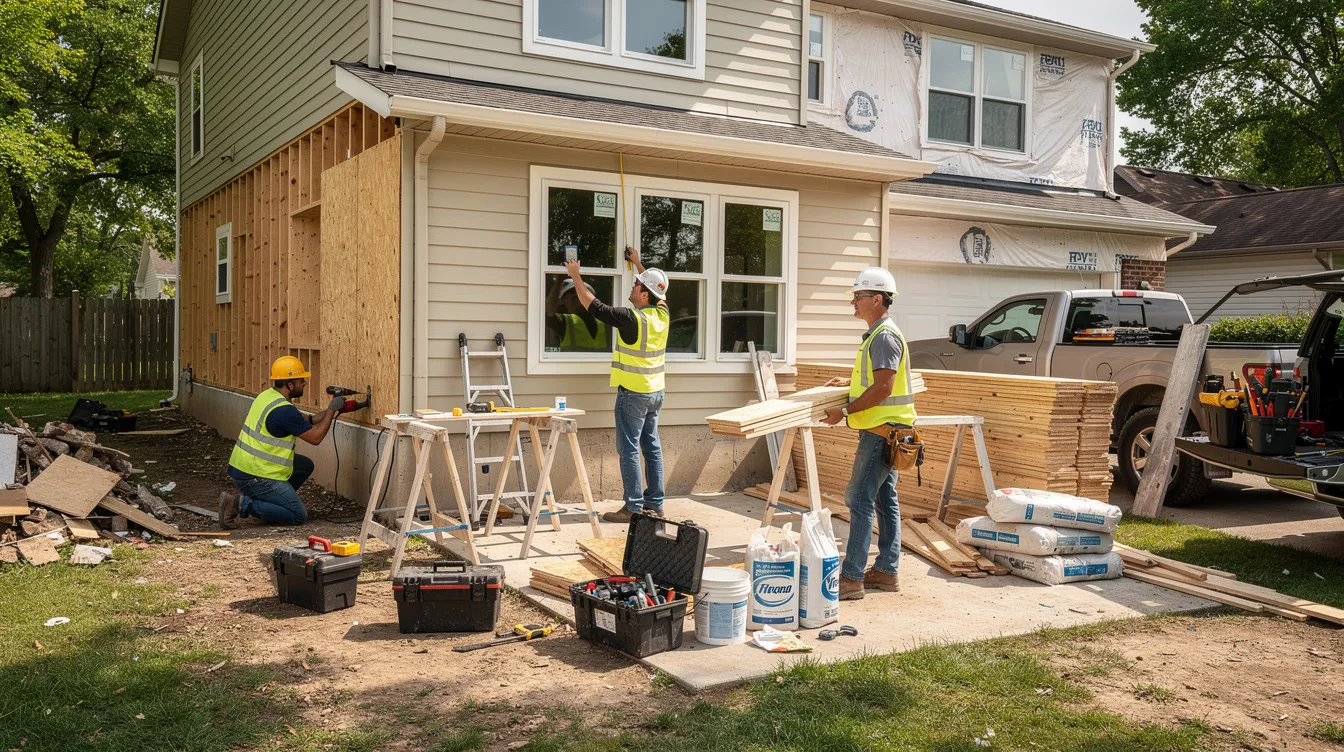
New business scenario: You're launching a contracting company and need $75,000 for equipment and marketing. You're not yet eligible for traditional business funding (most require two years in business and $20,000 per month revenue). A HELOC on your home fills the gap while you build revenue.
Gap Funded can help combine HELOC funding with other tools like 0% business credit card stacking and personal term loans to complete your capital stack. The HELOC calculator is also useful for evaluating whether a HELOC or a cash out refinance suits a specific project better.
HELOC vs. Cash Out Refinance vs. Other Funding Options
Borrowers often weigh a HELOC against a cash out refinance, unsecured term loans, and 0% business credit cards. Each has a place.
A cash out refinance replaces your existing mortgage with a new, larger one at a new interest rate and loan term. You receive the difference as cash. Refinancing replaces your mortgage with a new loan, unlike HELOCs which sit alongside your current mortgage as a second mortgage or revolving line of credit. If your existing first mortgage is at 3.5% and current market rates are 7%, a cash out refi means losing that low rate on your entire loan balance. Keeping the low rate and adding a HELOC on top is often cheaper overall, and the calculator can show you the difference.
Where unsecured options may beat a HELOC: if you have limited home equity, the property is ineligible, or you simply don't want a second lien on your home. Personal term loans and 0% credit card stacking carry no lien on your property, fund faster, and work well for smaller loan amounts like equipment, earnest money, or working capital.
Check out Gap Funded's gap funding overview for how mixed capital stacks work in practice.
The trade off is honest: HELOC rates tend to be lower than unsecured debt, but your home is collateral. A HELOC can risk foreclosure if payments are missed. If property values fall, your available credit line could shrink, and some lenders may freeze draws entirely. This isn't investment advice; it's a reality check.
Where the Funding Gap Appears and How Gap Funded Closes It
Here's what I see constantly: someone runs a HELOC calculator, gets excited about a $120,000 line, and then realises the deal actually needs $160,000 to close. The gap shows up in down payment shortfalls, $25,000 to $75,000 rehab overruns, reserves demanded by hard money or DSCR lenders, or startup working capital for a new business.
Gap Funded closes these gaps in a specific order that protects your credit profile:
- 0% business credit card stacking for flexible purchases (materials, marketing, smaller equipment)
- Unsecured personal term loans for larger sums (down payments, earnest money deposits, reserve requirements)
- Specialised gap funding products tailored to your deal structure
Sequencing matters. Applying out of order can knock out later approvals. We work with clients who typically have a FICO of 650 or higher, with stronger limits available at 680 to 740+. Pre-qualification uses a soft credit pull with no impact to your credit score.
We're not taking equity in your deal. No liens on the investment property. We help you layer a HELOC, unsecured funding, and other tools into one capital stack that actually covers the full number. For clients using HELOCs alongside high interest debt, our debt consolidation solutions can clean up the balance sheet before funding a new deal.
Debt Consolidation, Risk Management, and Paying Off a HELOC Faster
A heap of homeowners and investors use a HELOC for debt consolidation, rolling high interest credit card debt into a lower rate line. The calculator can show whether the new HELOC payment is genuinely more affordable.
Example: you're carrying $35,000 in credit card debt at 24% APR. That's about $700 per month in interest alone. Roll it into a HELOC at 8.5% APR, and your interest drops to roughly $248 per month. Over 36 months, the savings are substantial. Using a HELOC for non-essential expenses, though, can lead to debt accumulation, so keep the line disciplined.
Risks to keep honest about:
- Variable interest rates can rise, pushing your minimum loan payment higher
- HELOCs typically have variable interest rates that can fluctuate with the broader market
- Tying short term spending to home equity is risky if your financial situation changes
Strategies for paying off a HELOC faster:
- Round up your monthly payments above the minimum
- Make biweekly payments instead of monthly
- Apply flip profits, tax refunds, or bonus income to principal
- Rerun the calculator to model accelerated payoff schedules
Revisit your HELOC payment estimates whenever income, expenses, or interest rates change. Interest on HELOC funds used for home improvements may be tax deductible, which is another factor worth modelling with your accountant.
Step by Step: From HELOC Calculator to Funding Review with Gap FundedStep by Step: From HELOC Calculator to Funding Review with Gap Funded
Here's the practical roadmap from estimating your HELOC capacity to assembling a complete capital stack for a 2026 deal or new business launch:
- Gather your data: home value, existing mortgage or loan balance, credit score, income, pay stubs, and tax statements
- Run the numbers in a HELOC calculator to see your estimated credit limit and HELOC payments
- Define your funding goals: rehab budget, down payment, debt consolidation target, or minimum loan amount for a new venture
- Identify the remaining gap after your HELOC and existing HELOC or savings
- Choose supplemental tools in the right order: credit card stacking, then term loans, then gap funding
- Submit a quick application for a personalised funding review
You can apply online for a HELOC with required documentation, though the application process may require tax statements and pay stubs, and HELOC applications often involve a hard credit inquiry. Gap Funded's review, by contrast, uses a soft pull to check your options without dinging your credit.
We typically work with clients who have at least a mid 600s FICO, verifiable income or business revenue, and either equity in a property or strong enough credit for unsecured lines. If you've already crunched the HELOC figures and spotted a shortfall, that's exactly what we're built for.
Apply for a free funding review here and we'll help you work out which combination of tools gets your deal across the line.
Related Reading
This article is for educational purposes only and isn't financial, legal, tax, or investment advice. Credit and financing outcomes depend on your own situation. Talk to a licensed financial professional before making funding decisions for your business.